Dora Vota’s post-quantum migration introduces two complementary paths for transaction authentication: native ML-DSA-65 accounts and hybrid transaction authentication for existing accounts that retain their addresses. A separate migration replaces classical validator consensus keys with ML-DSA-65 keys. Together, these paths are intended to extend post-quantum protection to account and consensus signatures while preserving on-chain state.
This article describes the architecture, security boundaries, migration dependencies, and functional evaluation of the implementation. Post-quantum cryptography (PQC) here refers primarily to digital signatures for authentication and integrity; it does not imply encryption of transaction data.
Scope and status. This revision, updated September 17, 2026, describes the SDK v0.55.0 / CometBFT v0.40.0 target implementation. Implementation statements were checked against commit ee9972db79826a15ce6fa746c417c97fa891a94d; this document review did not rerun the experiments. The reported results were obtained in controlled, single-server test networks. Implemented capabilities and observed test outcomes are distinct from production activation: this article is not a statement that all accounts, validators, or interchain connections have completed migration. Production readiness and deployment require separate operational and security assessment.
1. Migration Rationale and Account Paths
The classical starting point uses secp256k1 for most account signatures and Ed25519 for validator consensus signatures. A sufficiently capable quantum computer running Shor's algorithm could break the discrete-logarithm assumptions behind both schemes. An account's public key is normally revealed when it first signs an on-chain transaction and may also be exposed elsewhere. A hidden public key is therefore not a substitute for migrating authentication.
For an existing chain, changing the signature algorithm also changes how users control their assets. A native ML-DSA public key derives a new account address. Balances, staking positions, contract administration, authz grants, feegrant allowances, and external account mappings do not automatically follow it.
The current account classifier admits secp256k1, ed25519, and secp256r1 public keys to the hybrid path. Composite multisig public keys and unknown key types are not supported. A transaction with multiple independent signers is distinct from a single account controlled by a composite multisig key; signer-index binding supports the former, not the latter.
Validator consensus keys follow a separate migration path. Rotating them changes the validator's consensus address, while preserving its staking operator identity. Protecting an operator account's transactions and protecting the validator's consensus votes are distinct tasks.
2. Native ML-DSA Support
The target dependencies use Cosmos SDK v0.55.0 and CometBFT v0.40.0. Their ML-DSA-65 support is built on Cloudflare CIRCL's implementation of the algorithm standardized in NIST FIPS 204. ML-DSA is a module-lattice-based digital signature algorithm designed to resist known classical and quantum attacks. Use of an algorithm standardized in FIPS 204 does not, by itself, constitute FIPS validation of the implementation or certification of the network.
2.1 Native Account Signing
An upgraded dorad can create a native ML-DSA account:
dorad keys add alice-pqc \
  --key-type ml_dsa_65 \
  --keyring-backend os \
  --home ~/.dora
The SDK derives the account address from the ML-DSA public key, signs transactions with the corresponding private key, and verifies them through x/auth.
Native ML-DSA accounts do not require an additional x/pqcauth signature. The current Ante implementation recognizes a verified native ML-DSA signature as satisfying the global PQC requirement, including REQUIRED mode. Such accounts cannot register pqcauth keys or attach a pqcauth authorization for themselves. Native accounts do not thereby acquire the dual-key registration, signing-key rotation, or recovery lifecycle supplied by x/pqcauth to legacy accounts.
2.2 Native Consensus Signing
Once governance permits the ml_dsa_65 validator public-key type, validators can sign proposals and votes with ML-DSA-65. Other nodes verify these signatures using the validator set, and commits contain the resulting consensus signatures.
The migration retains CometBFT's consensus protocol and each validator's operator identity. The SDK's MsgRotateConsPubKey schedules a new consensus key, and an ABCI validator update changes the active validator set. This protects signing with the new keys; it does not re-sign historical blocks or replace P2P node identities. The operational sequence is described in Section 4.2.
3. Hybrid Transaction Authentication with x/pqcauth
x/pqcauth adds ML-DSA authorization to eligible classical accounts without replacing their BaseAccount public key or changing their address. An ordinary protected transaction must carry both the existing Cosmos account signature and a valid ML-DSA-65 signature. In this article, “hybrid” denotes this conjunction of classical and post-quantum signature verification, not a new signature algorithm or a claim of multi-factor authentication. Protection depends on correct transaction binding, enforcement, and custody of the registered keys.
3.1 Transaction Verification
The additional ML-DSA signature is carried in ExtensionPQCAuth, inside TxBody.extension_options, the SDK's critical extension field. It is not placed in non_critical_extension_options, whose unrecognized entries may be ignored. Each PQC entry identifies the protected signer and its position in AuthInfo.signer_infos; native ML-DSA signers do not receive additional PQC authorization entries.

Figure 1. Simplified authentication path for an ordinary protected legacy-account transaction. Any failed authentication check rejects the transaction before business-message execution; it never falls back to classical-only authorization. Registration and recovery use dedicated lifecycle proofs, described below. Diagram source.
The AnteHandler validates extension placement and encoding, bounds transaction resources and verification work, verifies the standard signature, and then checks the ML-DSA authorization through VerifyPQCDecorator. Bank, staking, and Wasm messages run only after transaction authentication succeeds; business modules do not need to implement the same additional signature check independently.
The ML-DSA signature covers a deterministic PQCSignDocV1. It binds the network and chain, account number and sequence, signer identity and order, key ID, policy version, transaction body, and AuthInfo, including fee and gas. The PQC extension itself is removed from the canonical body to avoid signing a document that contains its own signature. Clients add the resulting extension before producing the standard Cosmos signature over the final transaction.
The cryptographic adapter signs an application-level domain-separated envelope:
D = ASCII application domain label (for transactions: "doravota/pqcauth/tx/v1")
M = canonical PQCSignDocV1 bytes
E = 0x00 || uint8(len(D)) || D || M
signature = ML-DSA-65.Sign(private_key, E, ctx=empty)
D is part of the message, not the FIPS 204 ctx argument. Passing D as ctx while signing M produces a different protocol and will not interoperate. Lifecycle proofs use the same envelope with their own domain labels and canonical messages. This SDK-native format is incompatible with the earlier direct-context format; an already deployed old format requires an explicitly coordinated protocol migration. Pure ML-DSA, an empty context, and deterministic signing are separate choices. The current wrapper uses all three; pure ML-DSA itself does not require the latter two. See the adapter contract and deterministic vector.
These bindings are designed to prevent cross-context replay and transaction substitution: verification checks the authorization against the chain, account, sequence, key-policy version, and transaction being processed. Protected transactions use SIGN_MODE_DIRECT.
3.2 Registration, Key Rotation, and Signing-Key Recovery
Registration atomically installs two distinct ML-DSA public keys: a routine signing key and a mandatory recovery key. It also enables account-level self-protection. The module stores public-key records and policy state, never private keys. Clients should keep the recovery private key offline and use it only for its authorized lifecycle operations.
Account-key and protection-policy changes submitted at height H normally become effective at H+1. Transactions within H therefore cannot start using a newly registered or rotated key halfway through the block. Governance parameter changes have their own activation rules, including a safety delay for tightening changes.
The lifecycle messages support registration, signing-key and recovery-key rotation, protection changes, revocation of inactive keys, and recovery of a lost signing key. Signing-key recovery authorizes a specific replacement transaction; it does not remove the requirement for the account’s standard Cosmos signature. It therefore restores access to the ML-DSA signing path, not to a lost classical account private key, and is not a general account-recovery mechanism. Lifecycle messages must execute directly at the top level, with authorization bound to the exact message, so authz, group, or contract nesting cannot bypass their proofs.
First registration has a separate trust boundary: no PQC key is yet bound to the account, so it relies on the classical signature plus proof of possession of both new keys. Registration must occur while that classical authorization remains trustworthy. The module supports an irreversible registration cutoff to restrict later enrollment; it cannot use a newly presented ML-DSA key to establish the rightful owner of an already compromised classical account. See the bootstrap policy.
3.3 Security Scope and Enforcement Boundaries
x/pqcauth protects account-initiated SDK transactions. It does not itself replace consensus signatures, IBC light-client verification, P2P identities, or signature checks implemented inside contracts. Registration does not automatically revoke delegated permissions. Instead, AuthzPQCDecorator rejects registration while the account still has outgoing authz grants or feegrant allowances. These are permissions granted by the registering account, not permissions it received from others. Enabling self-protection on a previously unprotected account also performs this check.
While self-protection is pending, new outgoing grants are frozen. Once effective, protected accounts may grant these capabilities only to recipients that satisfy the module's PQC-enforcement checks; delegated execution and fee-payment paths also recheck the applicable protection requirements. These controls do not automatically cover independently implemented contract, DAO, or group permissions, which require separate review.
PrepareProposal and ProcessProposal enforce transaction verification and aggregate resource limits as well. Under these handlers, transactions that fail the required proposal-stage authentication checks cause proposal rejection; bypassing mempool admission does not bypass those checks. Proposal acceptance does not guarantee that every business message will execute successfully.
4. Migration Sequence
The migration separates preserving chain state, upgrading account and consensus authentication, and extending coverage to the surrounding systems. After the target software is available, account and consensus work can proceed in coordinated tracks rather than requiring every account to migrate at one height.
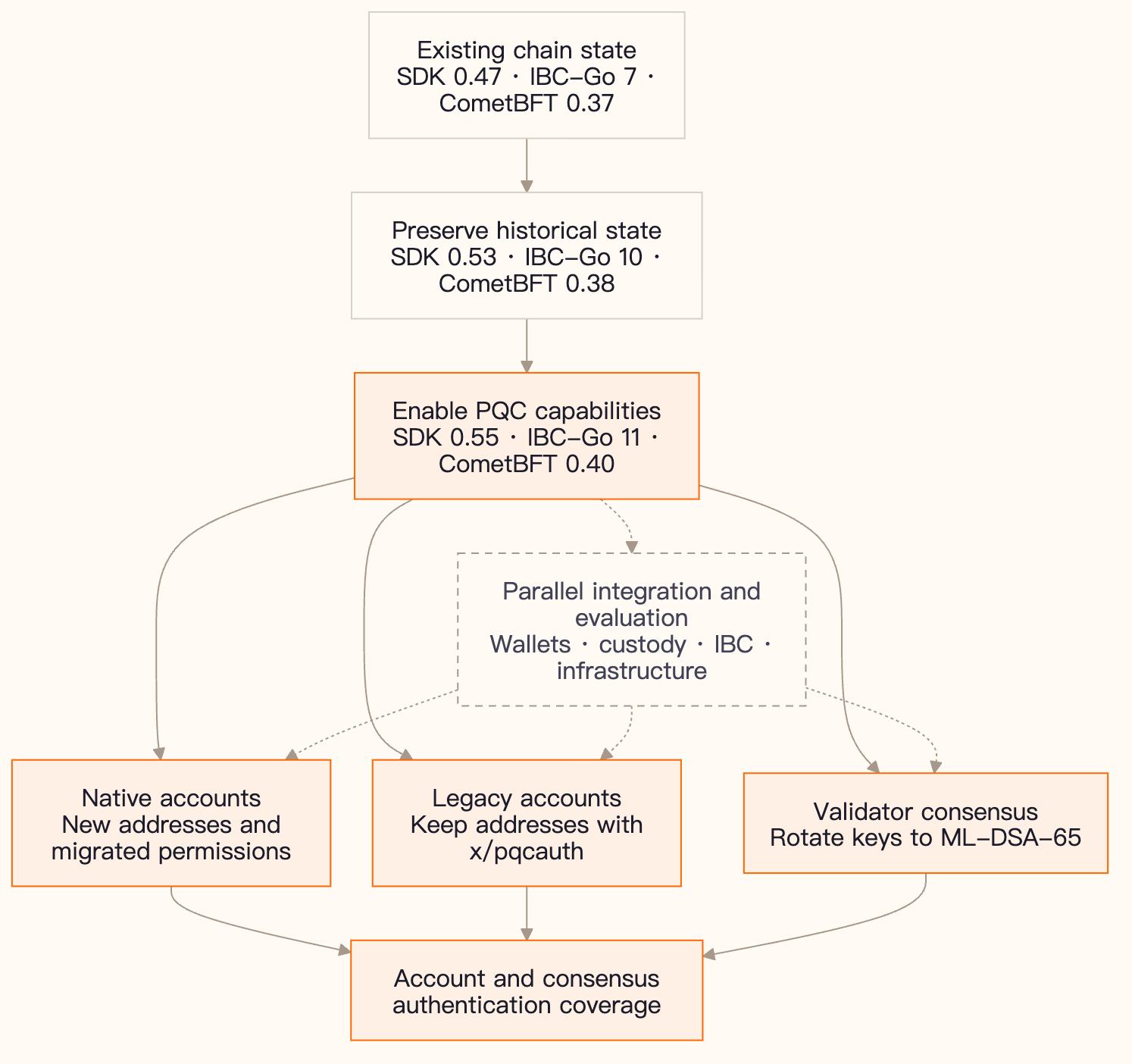
Figure 2. Software dependencies and parallel migration work, not deployment status. Solid arrows show the software upgrade path and the account and consensus capabilities it enables. Dashed links identify supporting work that can proceed alongside migration. Native and hybrid paths serve different account populations; neither the diagram nor core signing coverage implies end-to-end post-quantum security. Diagram source.
4.1 Preserve Application and On-Chain State
The supported upgrade path for the existing SDK v0.47 chain uses an intermediate SDK v0.53 / IBC-Go v10 binary before the SDK v0.55 / IBC-Go v11 target. This bridge is a historical-state requirement, not a cryptographic prerequisite: a new chain starting directly on SDK v0.55 does not need it.
Some migrations needed by the older state no longer exist in the target dependencies. The target's preflight check therefore rejects an unsupported source module-version map before starting migration. It does not silently skip missing history.
4.2 Rotate Validator Consensus Keys
A consensus-key rotation requires both an on-chain update and a coordinated change to the validator's signing infrastructure:
- Enable the supported key type. Update consensus parameters through governance to permit
ml_dsa_65, retaining key types required by validators that have not yet migrated. - Prepare signing infrastructure. Generate and securely provision the replacement key, verify signer compatibility, and rehearse backup and activation procedures before submitting an on-chain rotation.
- Schedule the rotation. Submit
MsgRotateConsPubKeyfrom the validator operator account using the applicable native or hybrid authentication path. Rotation remains subject to the SDK’s eligibility checks and configured fee. - Coordinate activation. Use the committed rotation event’s
apply_heightto coordinate the signer change. Preserve anti-double-signing state and ensure that more than two-thirds of total voting power remains online and able to sign validly. Do not run duplicate signers or reset signing state to force progress. - Verify the transition. Check staking state, the active CometBFT validator set, commits signed by the replacement key, and continued block production before proceeding with further rotations.
In our four-validator tests, we rotated one validator at a time while the other three continued signing. Production scheduling must account for voting power rather than validator count. Use the reported activation height rather than assuming a fixed offset from transaction inclusion. The four-validator experiment observed H+2; Section 6 describes a separate single-validator transition.
4.3 Migrate Accounts and Tighten Policy
New accounts can use native ML-DSA as soon as compatible signing tools are available. Existing users who can change addresses need explicit procedures for balances, staking, contract administration, and delegated permissions. Eligible classical users who must retain their addresses register x/pqcauth keys before the enrollment cutoff:
- Inventory and revoke outgoing
authzgrants andfeegrantallowances. - Confirm the revocations are committed and the corresponding grants are absent before submitting registration; do not rely on bundling revocation with registration.
- Submit the direct registration transaction with proofs for distinct signing and recovery keys.
- Wait until H+1 and query the effective keys and protection policy.
- Recreate only the required grants to recipients that satisfy the new enforcement rules.
Before governance enables REQUIRED, inventory unsupported public-key types, including composite multisig accounts, and complete an asset/permission migration or an explicitly reviewed compatibility solution. The current verifier rejects such signers in REQUIRED; enabling it first can prevent those accounts from transacting. Registration is not an escape path for an unsupported key type.
The relevant enforcement modes apply as follows to ordinary transactions:
An extension that is present must verify even in OPTIONAL mode. New registrations enable self-protection at H+1, so optional network-wide enforcement does not mean those accounts are unprotected. Policy tightening, wallet readiness, registration rules, and recovery procedures must be coordinated before enforcement expands.
5. Functional Evaluation and Measured Costs
Evidence status. The four-validator transaction counts and gas figures below are historical measurements, not results reproduced at the reviewed commit. Their exact binary commits, configuration snapshots, and raw result artifacts still need to be attached to this article for independent reproduction.
We tested the migration with four isolated validator processes on one server, each with its own home, database, ports, and consensus key. The setup also included four user wallets and four operator accounts.
The following outcomes were observed in the tested configuration:
- The SDK v0.47 → v0.53 → v0.55 upgrade completed, with matching application hashes (
AppHash) across the four nodes at the checked heights after each upgrade. This establishes agreement at those checkpoints, not an exhaustive verification of all migrated historical state. - Successful registration and hybrid transactions, with classical-only transactions from protected accounts rejected.
- Four Ed25519 → ML-DSA-65 consensus-key rotations, each observed at H+2, followed by continued block production after all nodes restarted.
- Native account signing was exercised by four successful transfers from two ML-DSA accounts. Across all scenarios, 53 transactions completed successfully; including the registration, transfer, and rotation scenarios described above.
5.1 Transaction Size and Gas
The comparison used the same SDK v0.55 binary and standard MsgSend, with four successful transactions per group. Sizes are decoded raw protobuf transaction bytes from RPC, not JSON response sizes. These are small-sample measurements from this test configuration, not throughput or latency benchmarks. Reported values apply to the observed transactions and configured gas schedule.
Hybrid authentication adds a 3,309 B ML-DSA signature plus extension metadata: 3,416 B above the classical baseline in this sample. The tested SDK CLI's native transactions also include the 1,952 B public key in SignerInfo, making them larger than the hybrid transactions, whose PQC public keys are already registered in module state.
Native transactions nevertheless used less gas than hybrid transactions in this configuration. They avoid the additional classical-signature check and the separately configured 250,000-gas pqcauth verification charge. A native account's first outgoing transaction used an extra 53,750 gas to store its public key. Gas is an execution-accounting measure; these figures do not establish relative wall-clock signing or verification speed.
5.2 Consensus and Network Costs
Consensus signatures are outside the transaction bytes and account Ante gas path. The 1 B and 10 gas difference between the two hybrid rows comes from ordinary payload encoding, not an extra consensus-signature check on the transaction.
With four validators signing a commit, signature bytes alone increase from 4 × 64 = 256 B for Ed25519 to 4 × 3,309 = 13,236 B for ML-DSA-65: an additional 12,980 B per commit, before encoding overhead. Larger validator sets increase that cost, and proposals and vote propagation also need measurement.
These single-server tests provide functional evidence for the exercised state transitions and key rotations. They do not measure inter-host latency, packet loss, failure-domain isolation, sustained throughput, or production-scale validator traffic.
6. IBC Compatibility Across Consensus-Key Rotation
We tested IBC compatibility by connecting two independent Dora Vota test chains on one server, with one validator per chain. We established IBC clients, a connection, and an ICS-20 fungible-token transfer channel, then rotated both chains' consensus keys to ML-DSA-65 without recreating the clients.
The tested relay sequence preserved the light client’s trust transition by first submitting a header signed by the old validator set that committed to the next validator set, followed by an ML-DSA-signed header. This describes the update sequence used in the experiment, not a universal procedure for all IBC client implementations or validator-set changes.
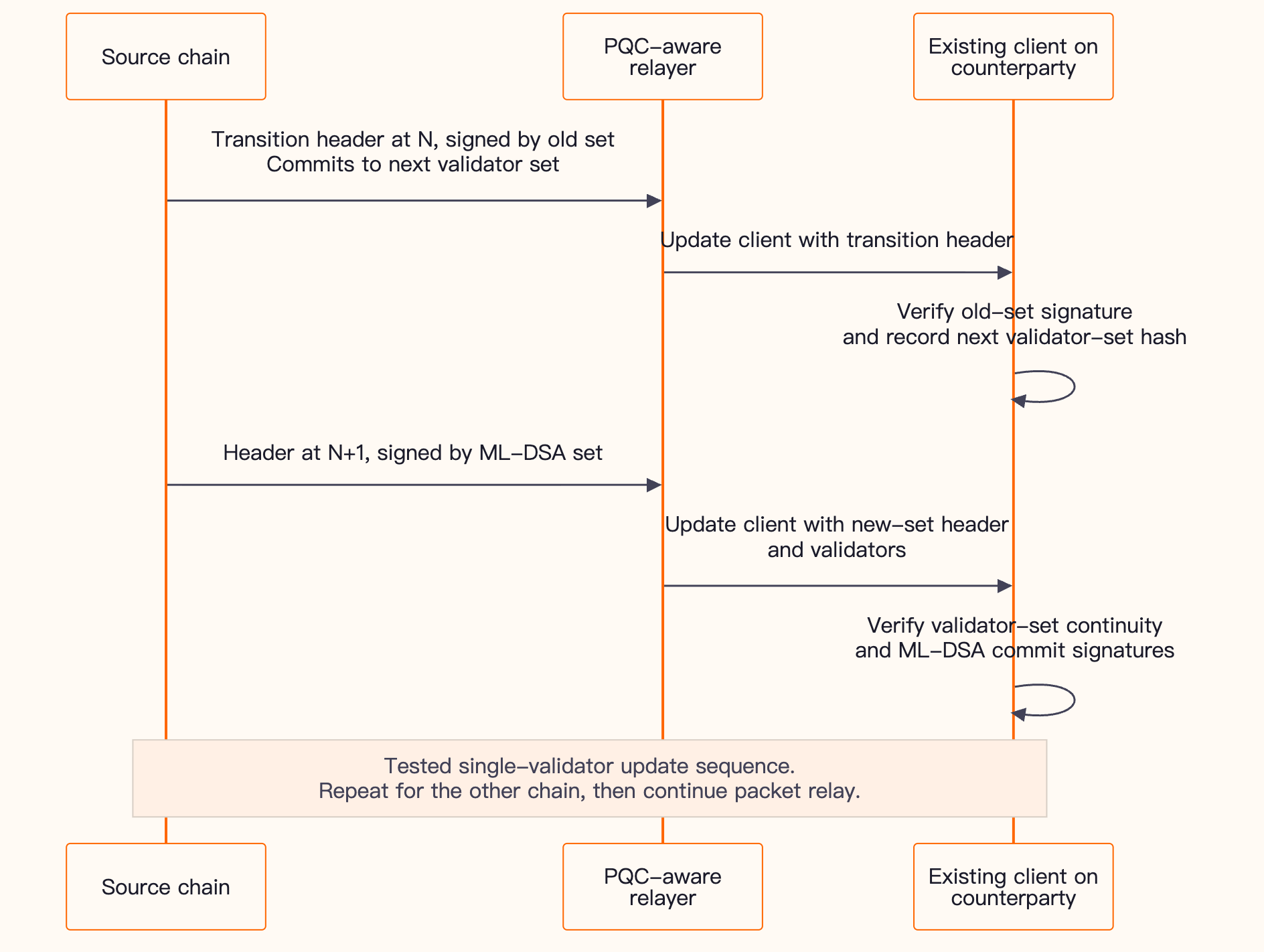
Figure 3. Header order in the tested single-validator transition. N denotes the transition header height, not the rotation transaction height. The relayer submits evidence; the counterparty light client verifies it. Diagram source.
The relayer used in the test supported ML-DSA header encoding, and its native ML-DSA account signed relay transactions. Account signing and light-client verification are separate requirements. Before rotating production consensus keys, verify that each counterparty's on-chain light-client implementation supports the ML-DSA public keys and signatures it will receive. Relayer encoding support or a native ML-DSA relay account alone is insufficient. The transition still depends on the existing trusted state and its security assumptions; it does not retroactively make historical trust roots post-quantum.
This demonstrates compatibility for the tested binaries and ICS-20 flow. It does not establish compatibility with every counterparty or IBC application. Multi-validator transitions, ICA, contract IBC callbacks, timeout paths, cross-host failures, and sustained relayer load remain to be evaluated.
7. Remaining Work and Production Readiness
The native and hybrid paths address different parts of transaction authentication. End-to-end security also depends on the systems that authorize, transport, and operate those transactions.
The deployment plan should preserve historical state first, make both account paths usable, and rotate consensus keys under voting-power and signer-readiness constraints. Each expansion of coverage requires separate evaluation. Functional interoperability, cryptographic assurance, and operational readiness are distinct claims; account and consensus signing milestones alone do not establish end-to-end post-quantum security.
For detailed behavior and implementation references, see the PQC Auth module documentation.