A site-resolved photon-counting system brings repeated neutral-atom circuits into the kilohertz regime while preserving readout accuracy and atom survival. A new strategic plan places that advance inside the larger path toward useful neutral-atom quantum computing.
0. Takeaways
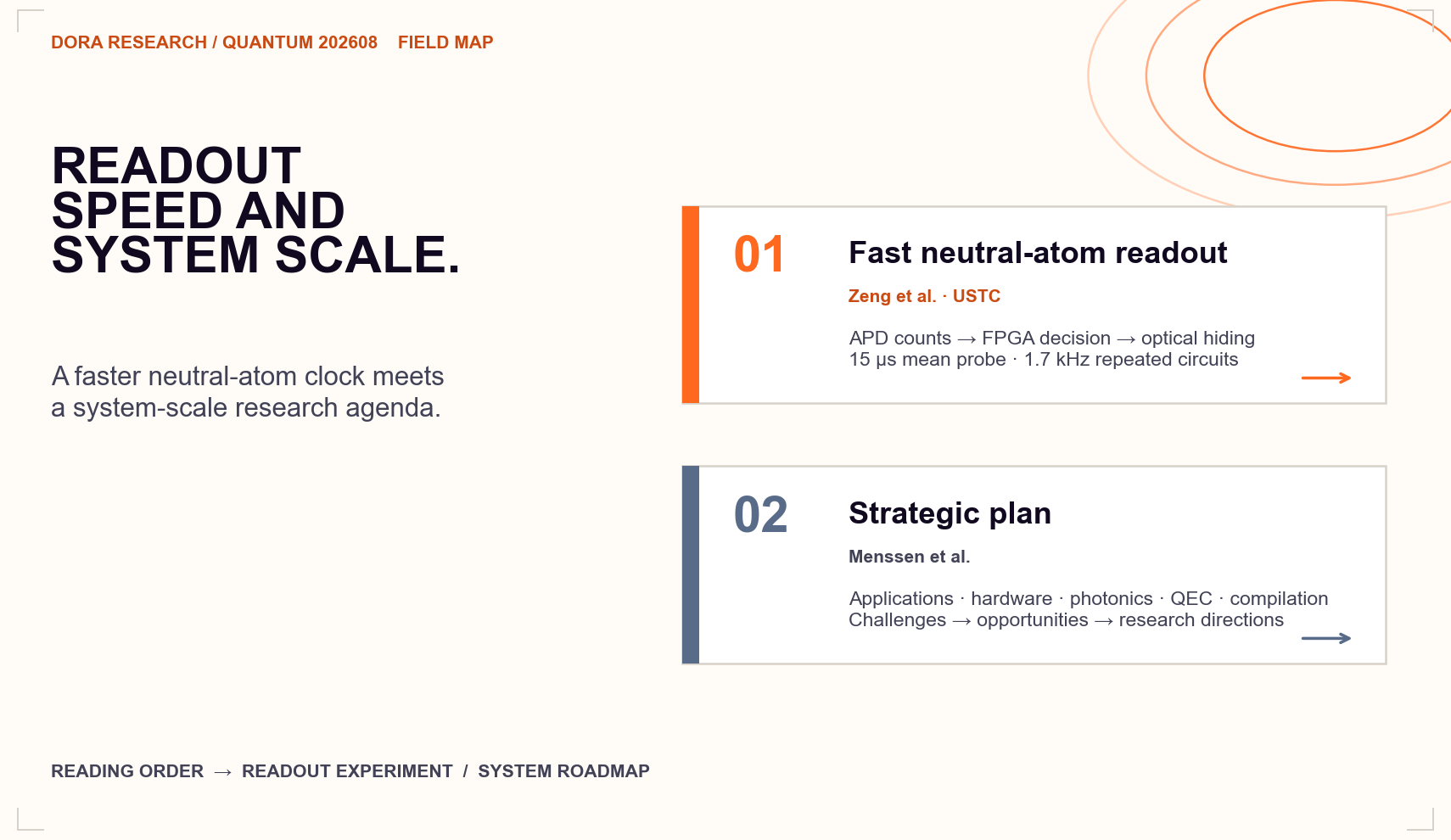
The researchers combine site-resolved photon counting, FPGA decisions and adaptive optical hiding.[1] Mean probe-on time falls to
The strategic plan frames neutral-atom computing as a systems-integration challenge.[2] Its opportunity lies in combining reconfigurable arrays with fast cycles, scalable optical control, low-overhead QEC, real-time decoding, hardware-aware compilation and verifiable applications.
1. Introduction
Neutral-atom processors have a speed problem. Their Rydberg entangling gates can finish in less than a microsecond, while fluorescence readout, atom motion and recooling often take hundreds of microseconds or several milliseconds. Measurement-heavy circuits inherit the slower cadence. Every syndrome-extraction round has to wait for ancilla readout, classical decisions and the operations that prepare the next round.
Recently, a resource estimate reduced the projected hardware requirement for ECC-256 to about 10,000 to 26,000 physical qubits using reconfigurable neutral-atom architectures.[3] (See our previous newsletter.) Its runtime calculations assume a 1 ms stabilizer measurement cycle, with the fastest construction taking about ten days. The paper places demonstrated readout and motion times between
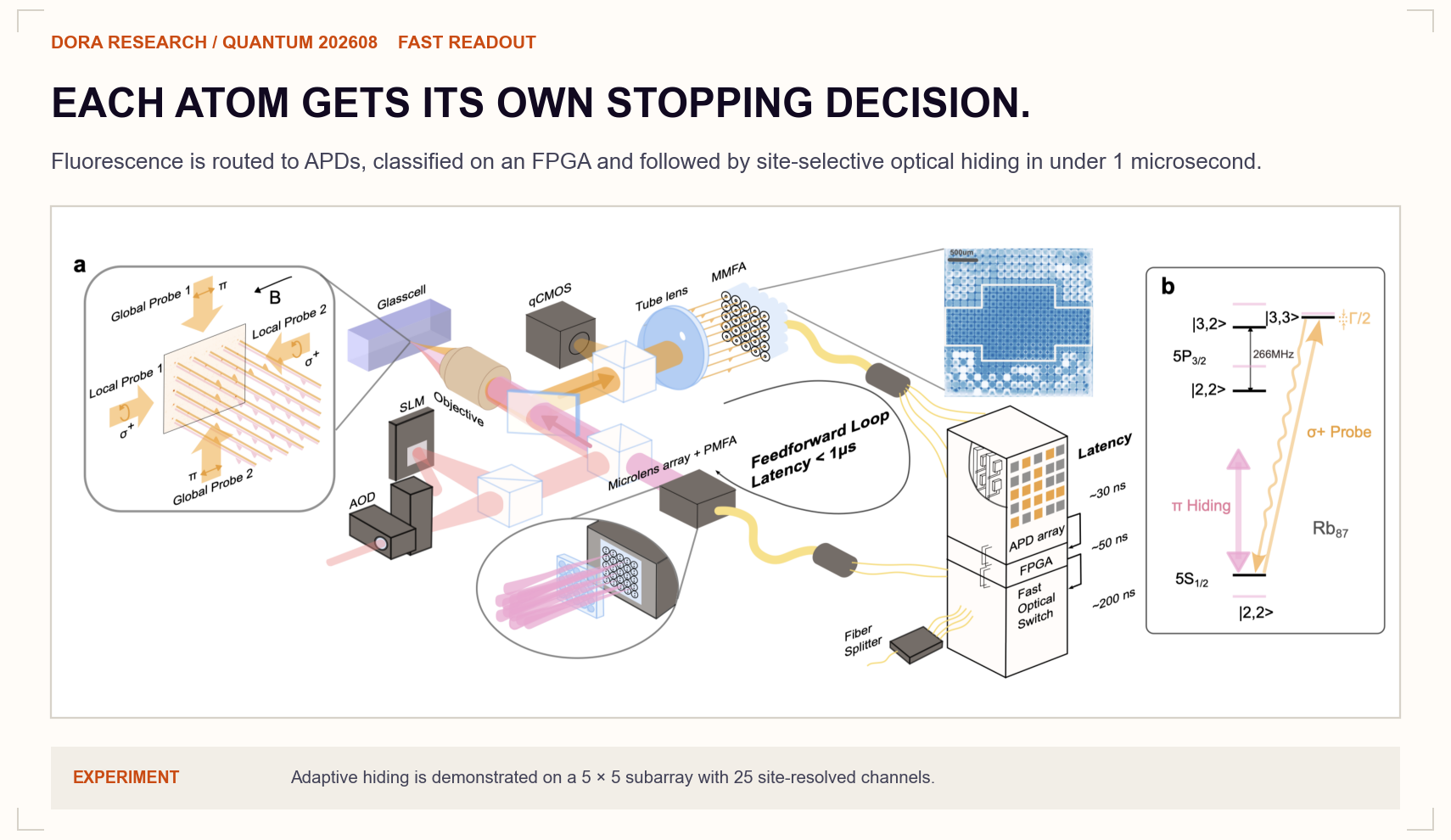
Now, Zeng et al. attack the measurement term directly.[1] They convert fluorescence readout from a camera exposure into parallel site-resolved photon-counting channels. An FPGA decides when each atom has supplied enough information, then a site-selective beam shields that atom from further scattering. This matters specifically for neutral-atom arrays because fluorescence can heat, depump or eject the same atoms that the processor hopes to reuse.
The experiment solves a sharply defined part of the clock problem. Menssen et al.'s Strategic Plan for Neutral Atom Quantum Computation supplies the wider view.[2] It asks which applications justify the machine, which hardware metrics must improve together, how optical control can scale, which QEC strategies fit reconfigurable arrays, and how software should connect algorithms to real-time control. Reading the two papers together turns a fast-readout result into a systems question: what becomes the limiting interface once measurement speeds up?
2. Fast nondestructive readout for neutral atoms
A camera frame keeps every atom waiting
Fluorescence readout distinguishes a bright state that scatters photons from a dark state that scatters very few. More photons improve confidence, yet every extra scattering event adds recoil heating and creates opportunities for depumping or atom loss. Neutral-atom processors need the atom after measurement, so survival carries nearly the same operational weight as the state assignment.
Conventional camera readout adds a second inefficiency. Atoms in tweezer arrays occupy known, widely separated sites. The measurement problem is therefore a set of binary channels at known coordinates. A camera still combines those channels into one frame, applies one exposure time, and postpones all state decisions until the frame closes. Many bright atoms continue scattering after their states have become obvious.
Zeng et al. replace that shared frame with a fast nondestructive readout architecture, abbreviated FNDR.[1] The adaptive experiment operates on a
Read the atom, then hide it
Photon clicks reach an FPGA running a calibrated likelihood-ratio discriminator. Once a site crosses the required confidence boundary, the FPGA triggers a fast optical switch. A corresponding 852 nm,
The experiment implements adaptive hiding on a
The architecture is tailored to neutral-atom arrays. It relies on separated trapping sites, fluorescence-based state detection and direct optical access to individual atoms, with photon counting and FPGA control providing the fast feedback loop.
Time-resolved decisions reduce the photon budget
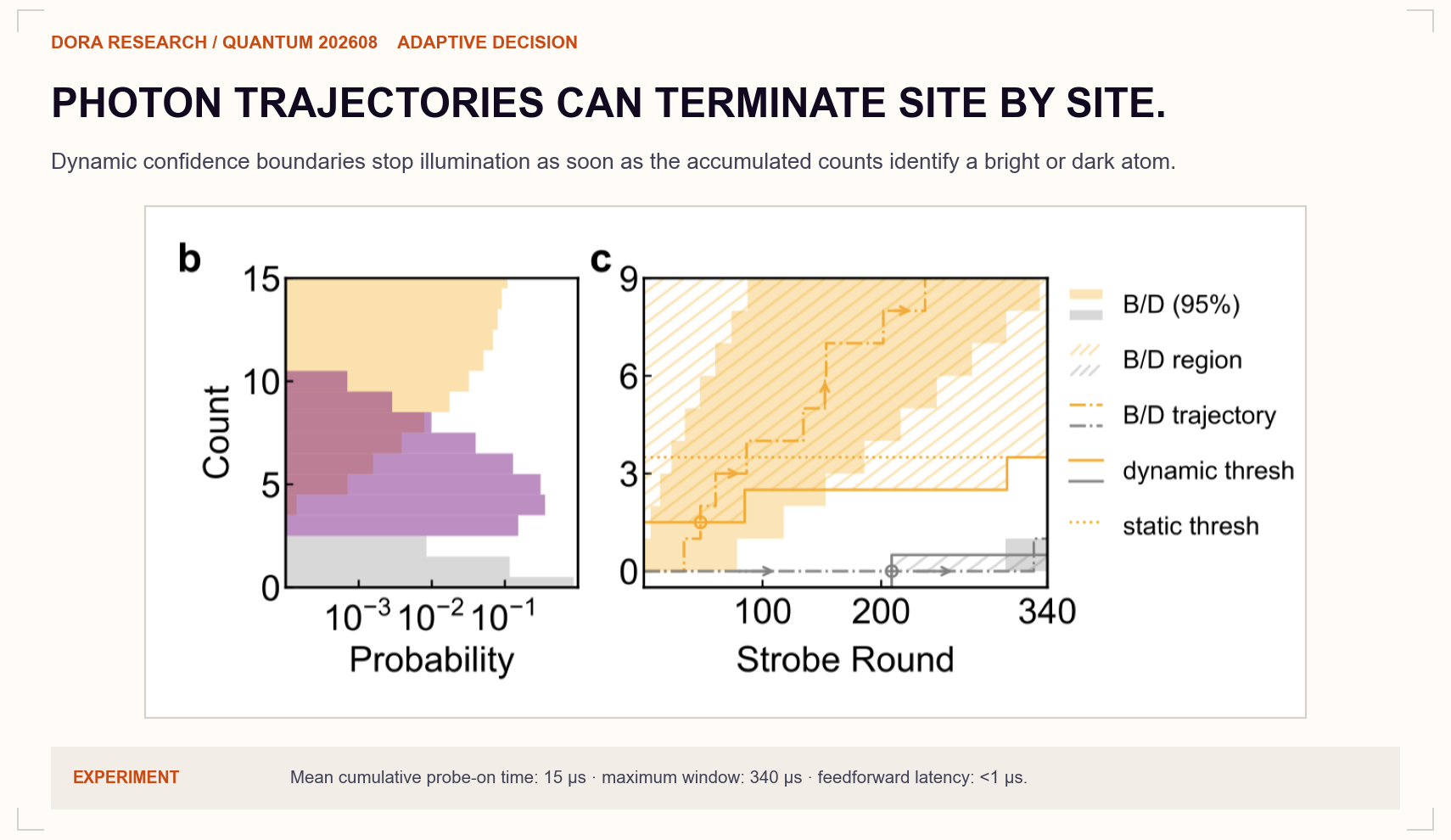
The probe and tweezer light are strobed. Each round lasts
Most atoms finish much earlier. Averaged across sites and outcomes, the cumulative probe-on time is
Accuracy and survival are measured separately
The authors benchmark the readout with three consecutive FNDR measurements followed by a state-insensitive atom-presence image.[1] Event strings from atoms prepared in bright or dark states separate incorrect state assignments from physical loss. The method estimates the rates directly from observed strings without fitting a photon-count model.
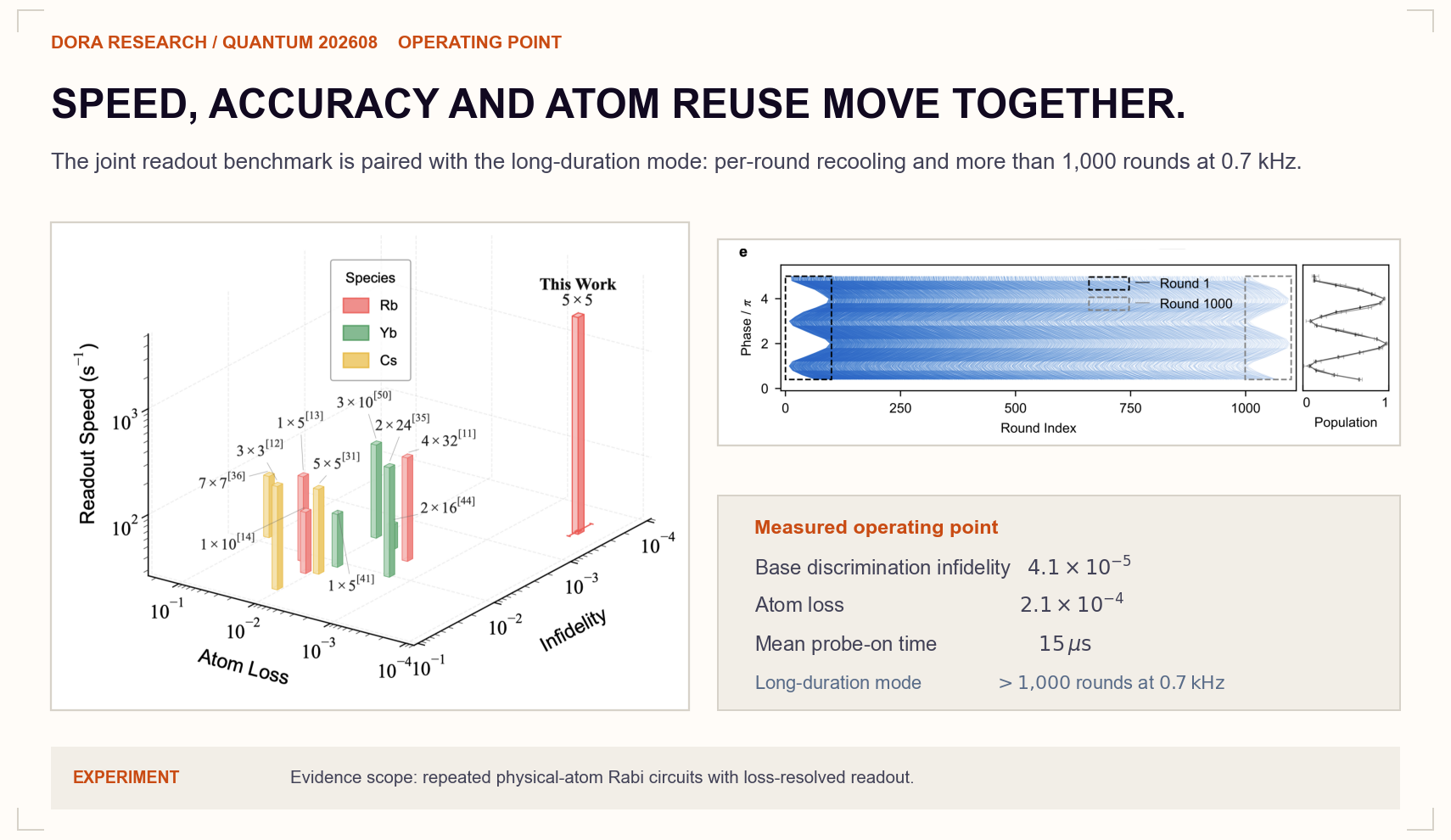
For the 25 adaptive channels, the bright-state discrimination error is
Hyperfine depumping is measured with a separate protocol and reaches
Together, these measurements place the experiment in a new region of the neutral-atom readout comparison. It combines array-scale operation, low state-assignment error, low loss and a sub-millisecond maximum window. The result is stronger than a speed record because the same optical process controls all four quantities.
Faster readout enables repeated atom reuse
The operational test places FNDR inside repeated Raman-driven Rabi circuits.[1] In the faster schedule, finite-field grey-molasses cooling is applied once every eight rounds. The processor reaches 120 rounds at 1.7 kHz while maintaining high survival. Applying recooling after every round extends operation beyond 1,000 rounds at 0.7 kHz. These schedules expose a direct trade-off between cycle frequency and accumulated motional heating.
The circuit contains physical qubit rotations and two loss-resolved FNDR measurements per round. Logical encoding and stabilizer extraction lie outside the demonstrated sequence. Even so, the experiment establishes the measurement, survival and reuse behavior that a future syndrome-extraction cycle needs. It also shows that cooling frequency becomes adjustable once each readout deposits less heat.
Zeng et al. project repetition rates near 5 kHz with technical improvements and higher photon-collection efficiency.[1] Their achieved rates are 1.7 kHz and 0.7 kHz. At larger array sizes, the channel count becomes the next engineering problem. Thousands of sites would require denser APD arrays and integrated electro-optic switch or modulator arrays. Faster transport and mid-circuit cooling would also occupy a larger share of the cycle budget.
3. A strategic plan for neutral-atom systems
Menssen et al. organize the field around a practical question: which technical advances would convert strong component demonstrations into useful computation?[2] Their plan spans applications, hardware, photonics, QEC, compilation and networking. Across these topics, reconfigurable atoms create opportunities through nonlocal connectivity and movable qubits. The associated challenge is coordination across many physical and software timescales.
Practical advantage starts with a verifiable target
The strategic plan defines practical quantum advantage through four conditions.[2] The computation should be correct, outperform available classical hardware, retain a scaling advantage as the problem grows, and matter to researchers beyond the hardware community. This definition forces resource estimates to connect an algorithm with a classical baseline and a verification method.
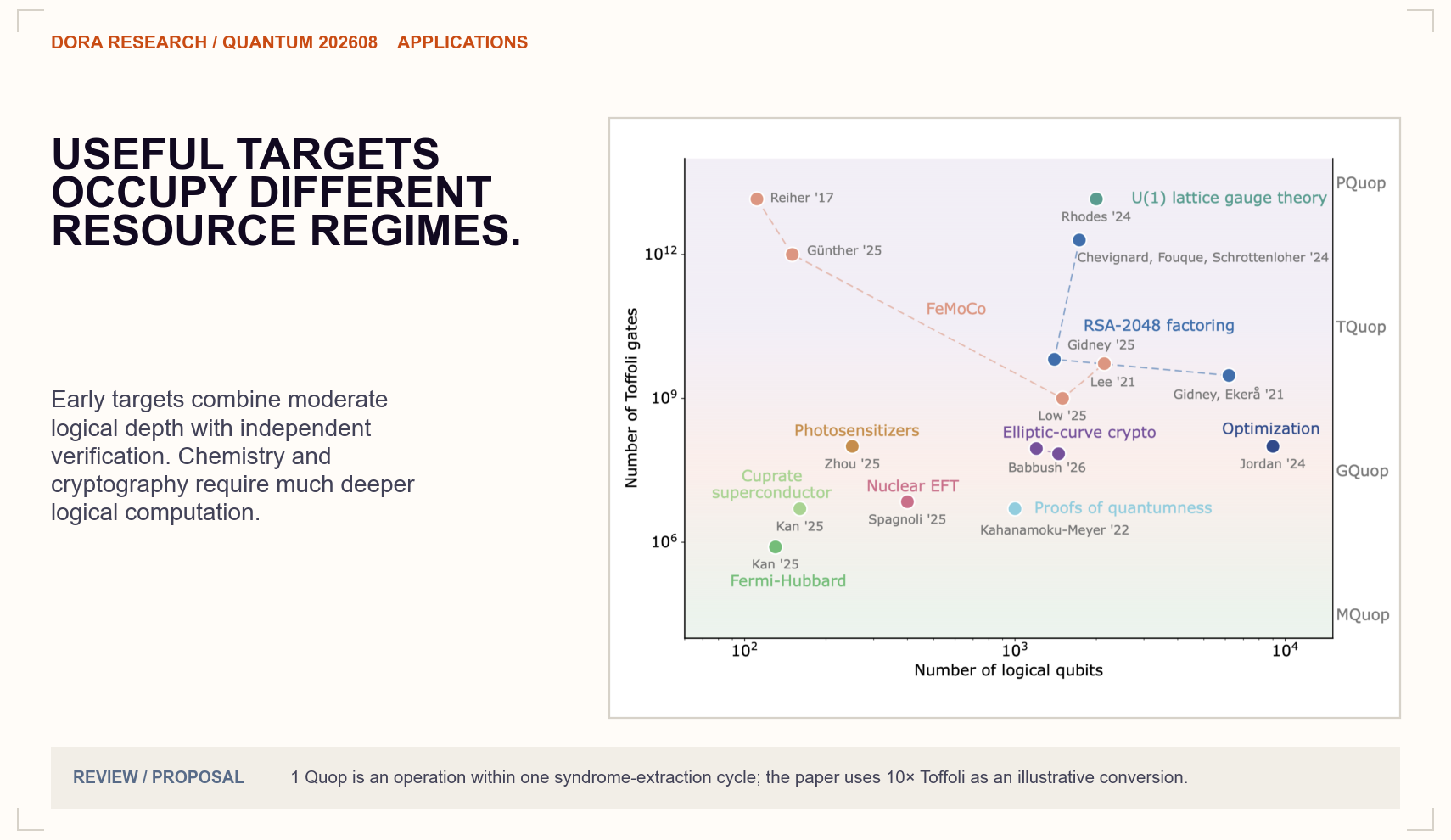
Menssen et al. use logical qubits and quantum operations, or Quops, to compare candidate workloads. One Quop denotes an operation completed within a syndrome-extraction cycle. Specialized simulations and proofs of quantumness may enter the mega-Quop regime with hundreds or low thousands of logical qubits. Chemistry, materials and cryptographic workloads often rise toward giga-, tera- or peta-Quop scales.[2]
The plotted Toffoli counts provide a lower-level resource proxy. A complete implementation also contains Clifford operations, syndrome extraction, routing and magic-state production. The paper uses ten Quops per Toffoli as an illustrative conversion, while the final factor depends on the architecture. The most useful role of the plot is to distinguish application regimes and to identify early targets that combine lower logical depth with credible verification.
Scale and fidelity have to meet in one processor
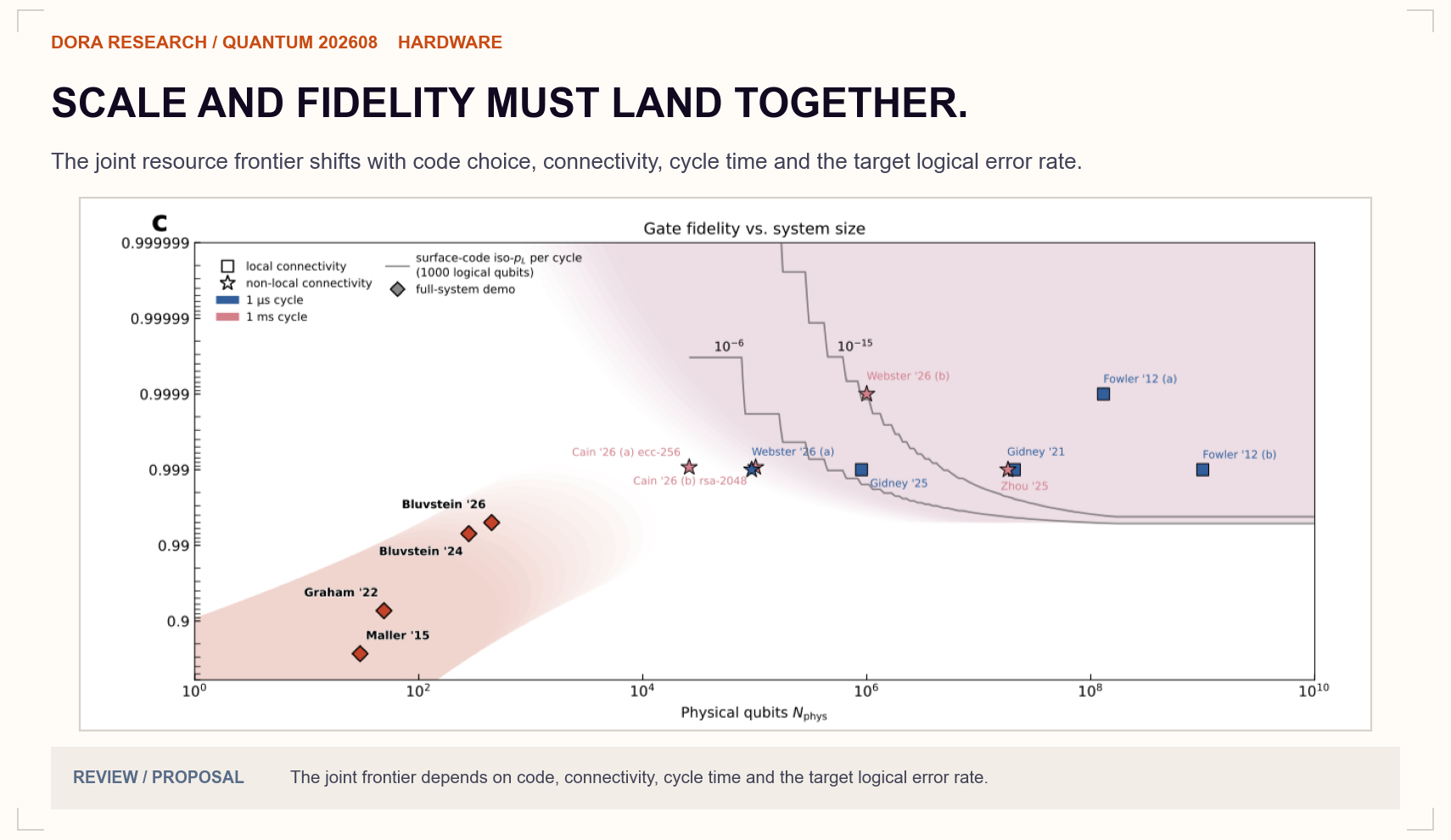
Neutral-atom experiments have produced rapid records in array size and two-qubit gate fidelity. Menssen et al. fit retrospective best-in-class data and obtain an array-size increase of about
A complementary set of resource estimates asks the more consequential question: which combinations of physical-qubit count, two-qubit fidelity, connectivity and cycle time support a target logical computation? Theoretical points shift with code family, logical error target and machine model. Many utility-scale studies land between 10,000 and 100,000 physical qubits under their chosen assumptions. Cain et al.'s ECC-256 architectures occupy this region and inherit the 1 ms cycle assumption discussed above.[3]
Large arrays and high-fidelity gates have often appeared in separate experiments. A useful processor must combine those properties with rapid measurement, continuous replenishment, stable calibration and sufficient optical power. Zeng's experiment helps on cycle time and atom reuse. It also makes the control problem more explicit: every adaptive channel needs detection, low-latency logic and site-selective light.
Optical control has to scale across wavelengths and bandwidths
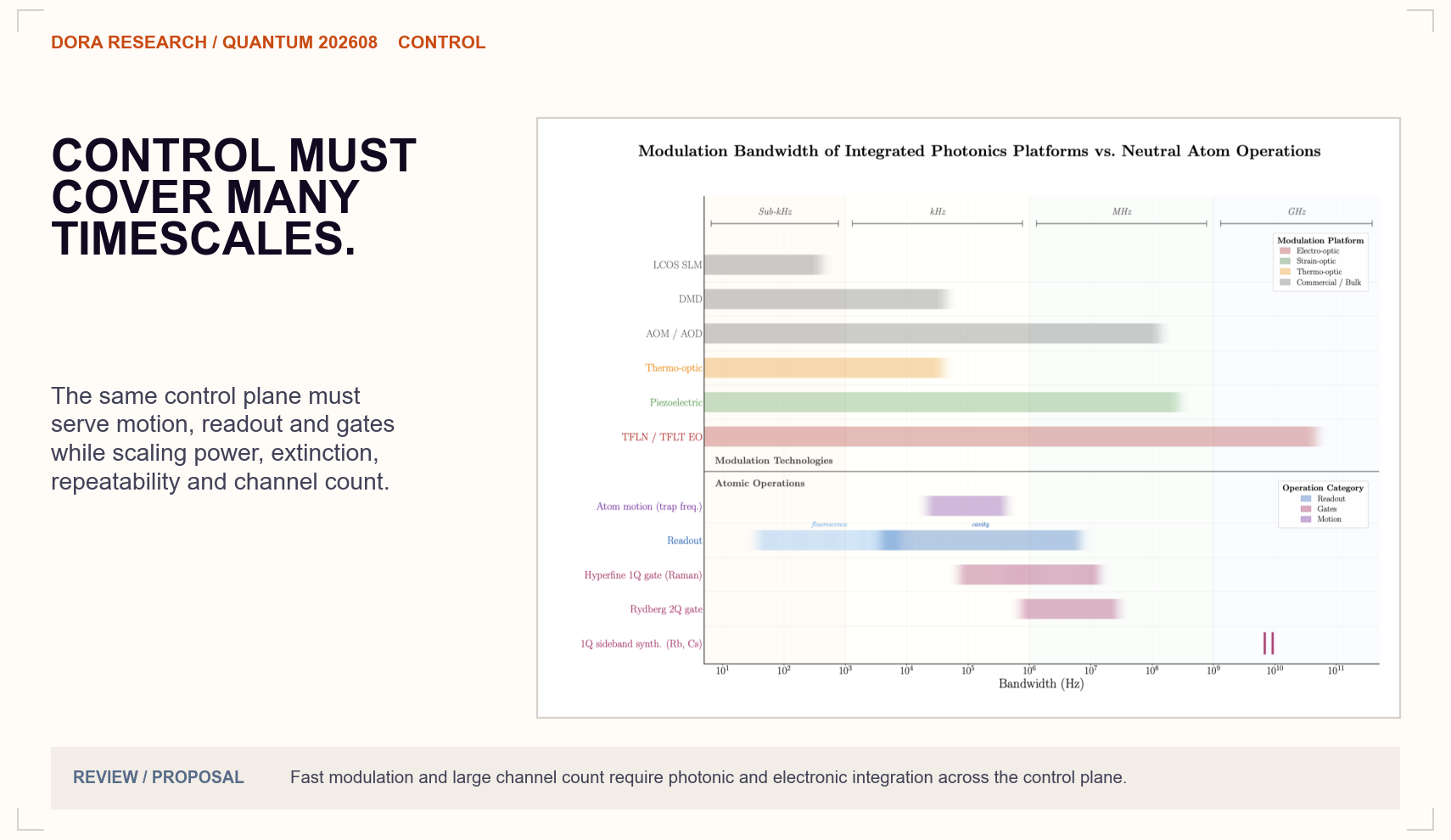
A neutral-atom machine uses light for trapping, rearrangement, cooling, state preparation, single-qubit gates, Rydberg gates and readout. Each operation occupies a different wavelength, power and bandwidth range. Bulk optics can deliver excellent performance to a laboratory-scale array, while thousands of independently controlled channels create constraints in footprint, stability, wiring and calibration.
Menssen et al. compare the modulation bandwidths of current and emerging platforms with the bandwidths required by atomic operations.[2] Liquid-crystal spatial light modulators provide many channels at relatively low speed. AOM and AOD systems reach much higher bandwidths with smaller channel counts and substantial optical infrastructure. Electro-optic and piezoelectric integrated devices cover wider high-speed ranges and offer a path toward denser control.
Bandwidth alone cannot select a photonic platform. The device must operate at the required atomic wavelengths, handle optical power, maintain extinction and pulse repeatability, and connect to fast drivers and local memory. Packaging and thermal behavior enter at the same scale as the photonic circuit. The strategic direction therefore couples integrated photonics with electronics and calibration software.
FNDR previews this architecture at 25 adaptive channels. The experiment joins APDs, FPGA logic, optical switches, fibres and microlenses in one closed loop. Expanding that pattern to thousands of sites will reward monolithic routing, denser detectors and local electronic control.
QEC can exchange movement for encoding rate
Reconfigurable atom arrays can implement nonlocal parity checks by moving atoms or changing interaction patterns. This capability makes quantum low-density parity-check codes especially attractive. A high-rate qLDPC block protects many logical qubits with far fewer physical qubits per logical qubit than a stack of surface-code patches. Lower space overhead can reduce the scale of a useful machine, while heavier and less local checks place more pressure on scheduling, movement and decoding.
Menssen et al. identify three linked QEC directions.[2] Universal logical gates need an efficient route beyond Clifford operations. Decoders must keep pace with hardware cycles that may span
Bhardwaj et al. provide a recent Caltech and Oratomic example through the mitten‑code family.[4] These codes have a 20% encoding rate and check weight 9. Under circuit‑level depolarizing noise with errors on state preparation, two‑qubit gates and measurement, the
The same study reports
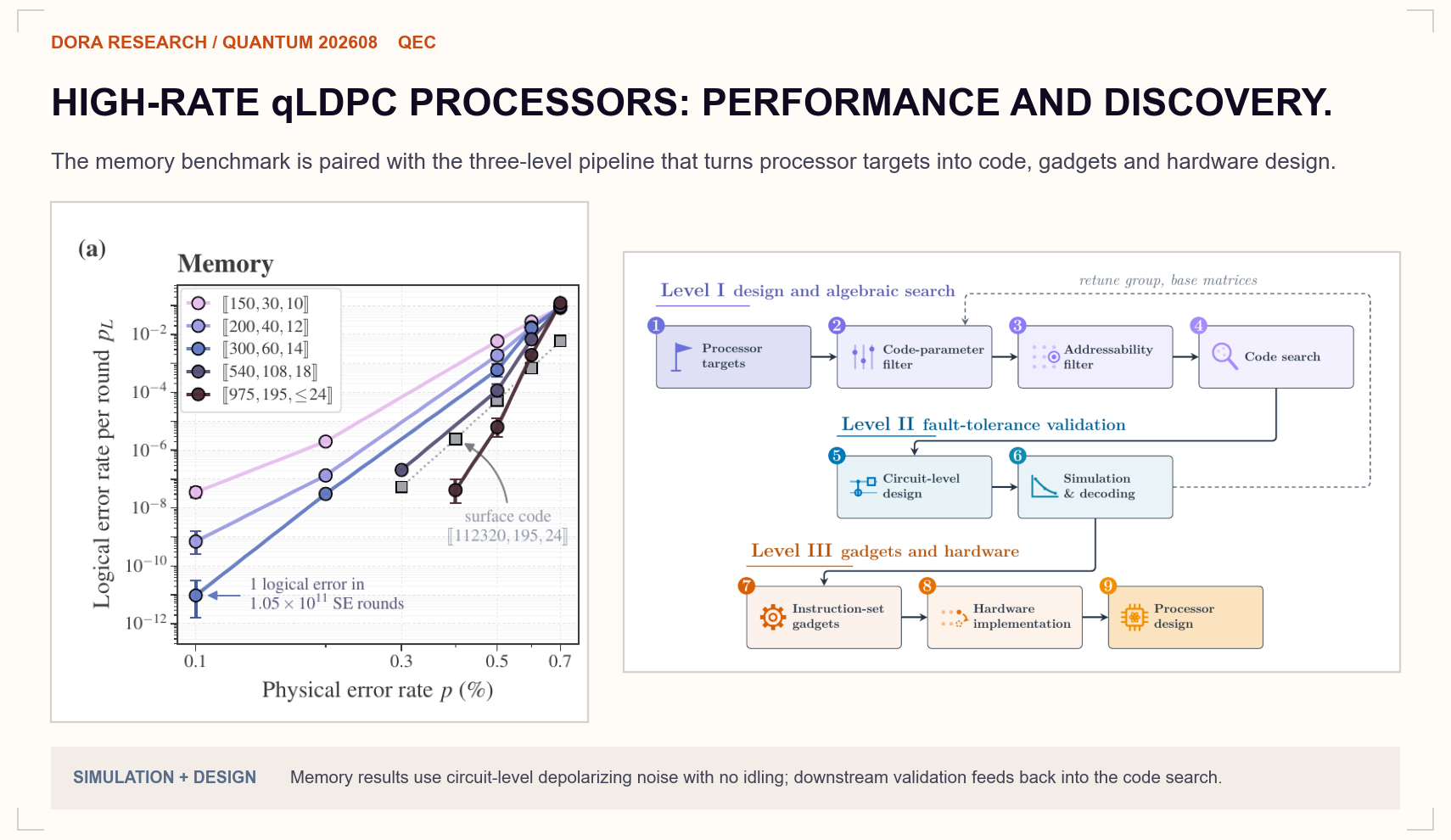
Zhao et al. pursue a related hardware‑code co‑design with QuEra, Harvard and MIT.[5] Their reconfigurable‑array construction reaches encoding rates above one half. At circuit‑level noise
Bhardwaj reports block-level memory error for several finite-rate qLDPC codes, while Zhao emphasizes the error per logical qubit per round. Their code families, decoders and simulation details also differ. Each paper shows how high encoding rate can reshape a neutral-atom resource estimate. Hardware tests of full syndrome cycles, realistic motion errors and universal logical operations remain the decisive next evidence.
Compilation connects the code to the controller
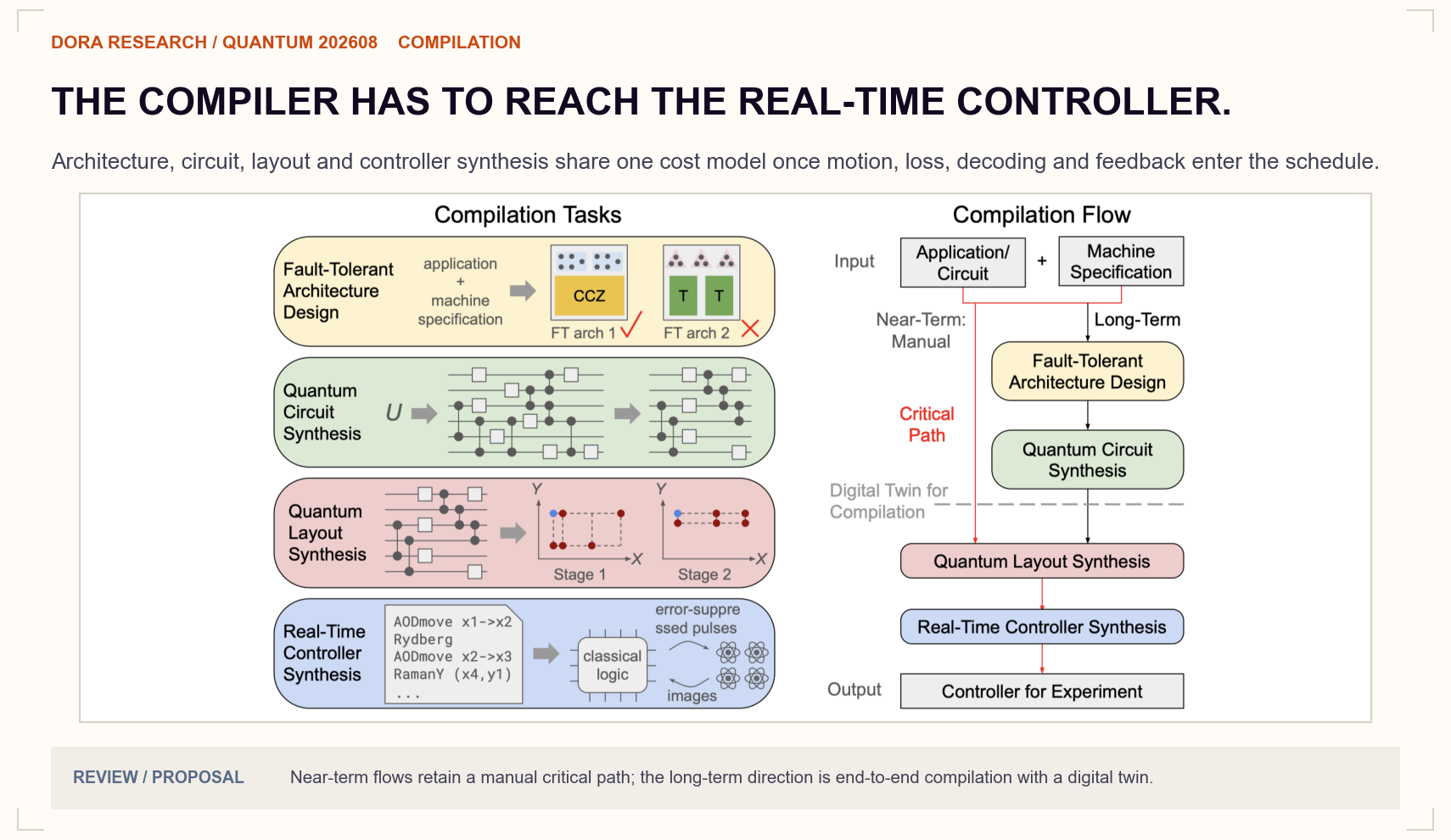
Atom rearrangement turns compilation into a physical scheduling problem. The compiler must choose a fault-tolerant architecture, synthesize the logical circuit, map interactions into stages of atom motion and gates, and generate real-time control instructions. Readout results, loss events and decoder outputs may change later stages while the experiment runs.
Menssen et al. divide this task into four layers: fault-tolerant architecture design, quantum circuit synthesis, quantum layout synthesis and real-time controller synthesis.[2] Near-term workflows retain manual choices on the critical path. The longer-term proposal joins the layers through a digital twin that estimates time, error and resource cost before hardware execution.
Fast readout changes this compilation problem in useful ways. A shorter and site-dependent measurement schedule changes atom shielding, cooling intervals and feedback deadlines. High-rate qLDPC codes change block layout, parity-check routing and decoder interfaces. Continuous replenishment adds reserve atoms and recovery operations. A shared intermediate representation for these events would allow compiler decisions to reflect the actual strengths and costs of the platform.
Networking is a later scaling branch
Menssen et al. also discuss modular networking.[2] A single apparatus may eventually encounter limits in optical power, field of view or control density. Entanglement links could connect smaller modules, though current remote atom-atom entanglement is slower and less accurate than local Rydberg gates. The useful link rate depends on the QEC architecture and its tolerance for photon loss. For the present generation, local cycle time, integrated control and continuous operation remain the more immediate system targets.
4. Conclusion
Zeng et al. show that neutral-atom fluorescence readout can operate as a local adaptive process.[1] Per-site photon counting and FPGA decisions stop scattering when each atom has supplied enough evidence. Adaptive hiding preserves the atoms for reuse. The measured result combines
This advance changes the cycle budget. Measurement can move from the dominant millisecond-scale delay toward the sub-millisecond regime assumed in ambitious neutral-atom resource estimates. Atom motion, recooling, replenishment, decoder latency and classical feedback then become a larger fraction of the wall clock.
Menssen et al.'s plan describes how the field can use that shift.[2] Practical advantage needs verifiable applications and current classical baselines. Hardware progress needs scale, fidelity and continuous operation in the same apparatus. Integrated photonics and electronics must distribute stable control across many wavelengths and timescales. High-rate qLDPC proposals can reduce spatial overhead when movement, decoding and logical operations are co-designed around the code. Compilation must carry those choices all the way to the real-time controller.
The next important neutral-atom result will combine several of these layers in one sustained logical experiment. Fast readout supplies a stronger clock. The remaining work is to make the rest of the processor keep time with it.
5. References
- Zeng, X.-Z.-Q. et al. "Fast Nondestructive Readout for High-Clock-Rate Atom Array Quantum Processor." arXiv:2608.17189 (2026). https://arxiv.org/abs/2608.17189
- Menssen, A. J. et al. "Strategic Plan for Neutral Atom Quantum Computation." arXiv:2607.21554 (2026). https://arxiv.org/abs/2607.21554
- Cain, M. et al. "Shor's algorithm is possible with as few as 10,000 reconfigurable atomic qubits." arXiv:2603.28627 (2026). https://arxiv.org/abs/2603.28627
- Bhardwaj, A. et al. "High-rate qLDPC processors." arXiv:2607.28795 (2026). https://arxiv.org/abs/2607.28795
- Zhao, C. et al. "Towards Ultra-High-Rate Quantum Error Correction with Reconfigurable Atom Arrays." arXiv:2604.16209 (2026). https://arxiv.org/abs/2604.16209