I. Introduction: The "Algorithm" of Effective Altruism and Its Underlying Commitments
Effective altruism (EA) is a contemporary ideological movement and applied ethical philosophy. At its core, EA is defined as "the use of evidence and careful reasoning to work out how to maximize the good with a given unit of resources… and the use of the findings… to try to improve the world" (MacAskill 2019). The movement has achieved real-world impact; for example, members of the organization Giving What We Can have pledged over $500M to highly effective charities, significantly shaping funding priorities in global health, animal welfare, and existential risk mitigation (MacAskill 2019). Beneath its public identity lies a foundation anchored in the tradition of moral philosophy. Specifically, EA practitioners adhere to an evaluative framework that is distinctly welfarist and consequentialist. The overarching normative aim is to bring about the best possible state of affairs for human beings and other sentient creatures by reducing suffering and preventing premature death. As Peter Singer famously puts it, the core idea is simple: "we should do the most good we can" (Singer 2015). While critics occasionally question whether the dominance of this consequentialist goal marginalizes other moral considerations, such as institutional justice or non-welfarist values, the movement remains steadfast in its pursuit of identifying interventions that yield the greatest expected utility.
To translate this consequentialist commitment into actionable policy, EA employs a rigorous, almost algorithmic methodology. When confronting global challenges, effective altruists recommend that moral agents evaluate problems based on three primary heuristics:
(1) The scale of the problem (how much it affects lives);
(2) its tractability (how easily progress can be made),
(3) and its neglectedness (how many resources are already dedicated to it) (MacAskill 2015).
These three features serve as the fundamental mechanism for identifying actions that possess the highest expected value. By adhering to this rationalist calculus rather than relying on emotional appeal, vividness, or political salience, EA proponents argue it is possible to pinpoint specific activities that are extraordinarily impactful. For instance, instead of funding local community projects out of personal attachment, an effective altruist might fund deworming programs in developing nations, because such interventions can be hundreds or even thousands of times more cost-effective than the median charitable intervention (Ord 2013).
However, operationalizing this expected value calculus necessitates strict epistemic standards. The movement places an extraordinarily high premium on quantifiable information that can be verified using scientific methods. Specifically, EA heavily favors interventions backed by randomized controlled trials (RCTs), establishing a hierarchy of evidence that often discounts qualitative or political evaluations (Gabriel and McElwee 2019). Through the application of these heuristics and epistemic standards, EA systematically categorizes moral interventions into distinct profiles. As Iason Gabriel and Brian McElwee argue, when it comes to severe global poverty, EA organizations almost exclusively favor "low-value/high-confidence" (LV/HC) initiatives. These interventions typically include "vertical" health programs - such as distributing antimalarial bednets - and direct cash transfers to the extreme poor. Conversely, the movement is highly willing to endorse "high-value/low-confidence" (HV/LC) projects, such as existential risk mitigation, calculating that the enormous scale of a potential cosmic payoff mathematically counterbalances an extremely thin evidential basis (Gabriel and McElwee 2019).
Yet, this strict epistemic dichotomy creates what Gabriel and McElwee term the "missing middle" (Gabriel and McElwee 2019). By focusing disproportionately on either hyper-verifiable micro-interventions (LV/HC) or highly speculative cosmic risks (HV/LC), EA systematically neglects "medium-value/medium-confidence" (MV/MC) systemic change initiatives. Efforts such as reforming the global tax system, fighting climate change, or empowering citizens politically are often sidelined because their nonlinear, institutional nature resists neat RCT validation.
Crucially, whether evaluating a localized anti-malaria net or the prevention of human extinction, the entire consequentialist machinery of Effective Altruism relies on an implicit, yet structurally load-bearing, philosophical premise: impartiality, which is the idea that the moral weight of well-being of every value patient is equal. In calculating the "greatest good," the geographic, temporal, or relational distance between the moral agent and the beneficiary is deemed normatively irrelevant. A unit of suffering alleviated in one's immediate community holds the exact same moral weight as a unit of suffering alleviated on the other side of the globe. This unwavering commitment to impartial aggregation forces the moral agent to adopt an Archimedean point—what Henry Sidgwick famously called "the point of view of the Universe" (Sidgwick 1907)—evaluating outcomes from a purely objective, global perspective.
The idea of impartiality usually combines with another idea: agent-neutrality, which holds that we assign moral weight to everything in the same way and thus the moral aim of everyone is the same. One can reject agent-neutrality by accepting agent-relativity. Agent-relativity means that everyone has different weights assigned to different value bearers (people, which can also be extended to AI, post-humans, animals, plants, and everything else) in the world (for example, you may value your family and friends more), and thus the ideal world is different for everyone. This combination of "impartiality + agent-neutrality" is not a logical entailment. We can endorse one without adopting the other. But it is very natural to believe both at the same time: There is a point of view of the Universe, under which we are all equal, and the morally ideal world in this point of view is our shared goal.
II. Parameter Explosion: Longtermism and the Unfolding of the Infinite Context
While effective altruism is perhaps best known for its recommendations regarding severe global poverty - where it focuses almost exclusively on low-value/high-confidence (LV/HC) initiatives like direct cash transfers and vertical health interventions - its underlying mathematical logic naturally propels it toward radically different frontiers. The relentless pursuit of expected value maximization dictates that moral agents must explore causes where the potential payoff is astronomically large. In decision theory, the expected value (EV) of an action is calculated by multiplying the value of its outcome by the probability of its occurrence (
This pivot is theoretically formalized as "longtermism," defined as the view that "positively influencing the longterm future is a key moral priority of our time" (MacAskill 2022; Greaves and MacAskill 2021). Longtermism is heavily endorsed by the contemporary technology sector, particularly within Silicon Valley. The tech community often operates under an "enlightenment worldview," which posits that human suffering and systemic failures persist primarily because humanity has not yet applied sufficient reason and scientific evidence to our challenges (Gabriel and McElwee 2019). This worldview frames global problems as technical deficits rather than political conflicts. When applied to the distant future, this mindset treats the survival and expansion of the species as the ultimate engineering challenge.
Tech leaders and EA-aligned philanthropists channel immense resources into mitigating existential risks - defined as events that threaten "the premature extinction of Earth-originating intelligent life or the permanent and drastic destruction of its potential for desirable future development" (Bostrom 2013). These risks prominently include unaligned artificial general intelligence (AGI) and engineered pandemics (Ord 2020). The expected value calculus here is straightforward: because future generations could number in the trillions - especially if humanity achieves interstellar colonization or digital consciousness - reducing the probability of extinction by even a microscopic fraction yields a mathematically staggering expected utility (Bostrom 2003). For instance, if the far future holds a carrying capacity of 10^24 potential lives, reducing the near-term risk of extinction by just one-in-a-million is equivalent in expected value to saving 10^18 lives today (Greaves and MacAskill 2021).
However, the parameters of this consequentialist calculus explode entirely when we introduce the concept of the infinite. In the technology sphere and modern cosmology, foresight models do not stop at astronomical but finite descendants; they extend into unbounded conceptual territories:
Diachronic (Temporal) Infinities: Transhumanist and post-humanist trajectories suggest that future digital minds could exist indefinitely. Furthermore, popular probabilistic models in tech, such as simulation arguments, posit the existence of endlessly nested simulated universes, introducing the possibility of an infinite number of future generations (Bostrom 2011; Tarsney and Wilkinson 2025).
Synchronic (Spatial) Infinities: Contemporary cosmological models, including eternal inflation, suggest an infinitely expanding universe or a multiverse. This implies an infinite number of sentient lifeforms existing concurrently across space (Tarsney and Wilkinson 2025).
When infinite values enter the EV equation (EV=Probability×∞=∞), the standard arithmetic of risk-neutral totalism breaks down. This leads to a severe decision-theoretic crisis known as fanaticism: a structural compulsion where any non-zero probability of an infinite payoff mathematically obligates the moral agent to sacrifice any finite, secular good (Wilkinson 2022).
By fixating on the mathematical extremes of the infinite future, this longtermist iteration of EA exacerbates what critics identify as the problem of the "missing middle" (Gabriel and McElwee 2019). Effective altruist meta-charities systematically prioritize either extremely well-evidenced, localized initiatives (LV/HC) or extremely high-impact, poorly evidenced cosmic projects (HV/LC). Consequently, medium-value/medium-confidence (MV/MC) initiatives - such as systemic institutional reforms, tax justice, or climate change policy - receive relatively little support. Driven by a preference for technical solutions and a neglect of complex political realities, the algorithmic logic of longtermism bypasses the messy, institutional conflicts of the present to optimize for a boundless, infinite future.
Yet, this theoretical extrapolation comes at a fatal cost. As we will explore in the next section, introducing actual infinity into an impartial welfarist calculus does not merely distort philanthropic priorities; it fundamentally breaks the mathematical and philosophical machinery of consequentialism itself.
III. Algorithmic Deadlock: The Crisis of Infinite Ethics
At its theoretical core, the engine driving effective altruism (EA) is the expected value (EV) maximization model. In practice, EA interprets the "greatest good" through a welfarist and consequentialist evaluative framework, aiming to identify interventions that yield the greatest expected utility. In finite contexts, this algorithm is mathematically elegant and functionally robust: the expected value of an action equals the sum of the value of all its possible outcomes multiplied by the probability of those outcomes occurring, expressed as
1. The Collapse of Aggregation: Cardinal Arithmetic vs. Strong Pareto
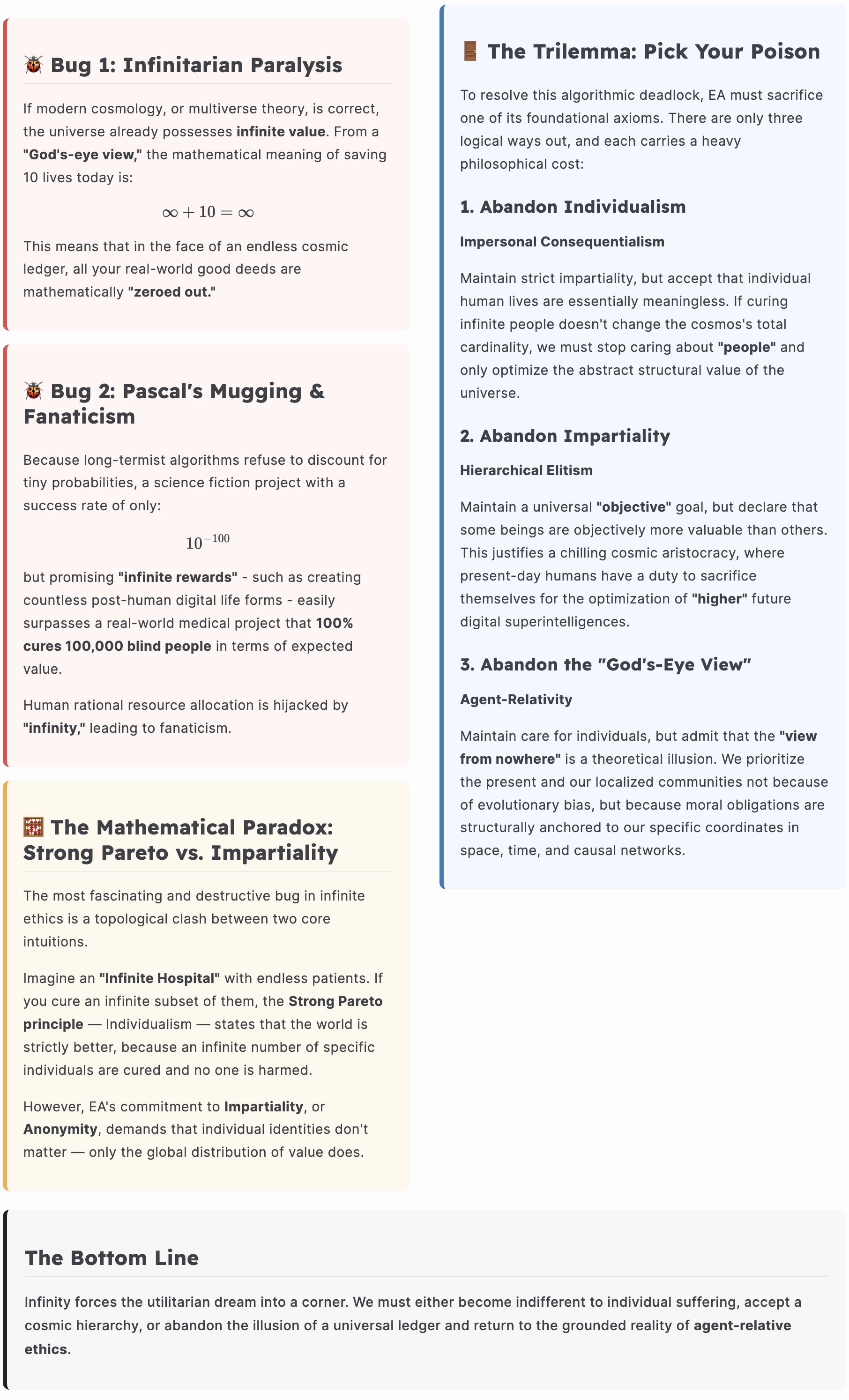
The first fatal logical dilemma stems from the failure of standard cardinal arithmetic in the face of infinity. Assuming that modern cosmology's eternal inflation model or multiverse theories are correct, the current universe is highly likely infinite in space or time. This means it already contains an infinite number of lives with positive and negative well-being (Bostrom, 2011). Consequently, the total value of the current world, from an objective "God's-eye view," is already infinity (∞).
Now, suppose you face a mundane philanthropic choice: you could donate a sum of money to an anti-malaria foundation, which would certainly save 10 children's lives (Action A); or you could do nothing philanthropic and spend the money on luxury goods (Action B). In a standard finite model, the incremental value of Action A is significantly greater than Action B (+10>0). However, in infinite ethics, the calculation for the universe's total value becomes: ∞+10=∞.
Consider a even more counter-intuitive example: the contrast between killing one million people and healing one million people. In an ordinary moral framework, these actions could not be more different. One is a catastrophe; the other is a tremendous achievement. But in an infinite world, both seem to leave the total value of the universe unchanged:
The impact of these two seemingly disparate actions is diluted into mathematical indifference. The infinite ledger swallows the finite difference. This means that no matter how many finite good deeds you perform in a localized segment of the world, the aggregate value of the universe remains mathematically unchanged (Bostrom, 2011). This leads to what Nick Bostrom famously terms "infinitarian paralysis": classical aggregative consequentialism seems to imply that all humanly possible acts are ethically equivalent, effectively stripping moral agency of its meaning (Bostrom, 2011).
2. Fanaticism and Pascal's Mugging
The second, even more destructive decision-theoretic issue is "fanaticism" - the structural compulsion to pursue the infinite product of minuscule probabilities. Because the longtermist framework is predicated on expected value (EV) maximization, it is inevitably drawn to high-value/low-confidence (HV/LC) interventions. Effective altruists frequently endorse highly speculative causes - such as mitigating existential risks - calculating that the enormous scale of a potential payoff mathematically counterbalances an extremely thin evidential basis. However, when cosmological scenarios, simulation arguments, or post-human digital lives are introduced into these models, the potential payoff scales to actual infinity.
This leads to an extreme version of what Nick Bostrom famously termed "Pascal's Mugging" (Bostrom, 2009), formalized in infinite ethics as infinite fanaticism (Bostrom, 2011; Beckstead and Thomas, 2024). Imagine a classic decision tree scenario:
- Intervention X (Deterministic Real-World Intervention): A 100% probability of generating (
) units of mundane, finite well-being (e.g., funding a proven global health initiative to cure a specific number of blind patients). . - Intervention Y (Highly Speculative Longtermist Project): A fringe tech startup claims they are developing a cosmic simulator that will create an infinite number of happy digital lives, but the epistemic probability of success is a microscopic
.
Under standard expected value theory, the calculation for Intervention Y is:
Because
3. The Limits of Impartiality
Why does a seemingly rational expected value algorithm lead to such an absurd deadlock? The primary culprit behind this systemic collapse is precisely effective altruism's obsession with its core presuppositions: absolute impartiality and strict agent-neutrality.
Jacob Nebel astutely argued (Nebel, 2025) that if we operate under an individualistic ethics - wanting what is best for each of infinitely many individuals - and we wish to remain rational, the mathematical reality of infinity forces us to reject strict impartiality. Nebel demonstrates that to avoid paralysis in infinite contexts, "we must care about some individuals more than others" (Nebel, 2025). As long as all value must be forcibly placed into a "global ledger" for indiscriminate aggregation - ignoring spatiotemporal distance, causal chains, and an agent's special obligations - the system will inevitably break down in the face of infinity. Confronted with a boundless universe, no finite, localized effort can ever leave a trace on this absolutely neutral scale.
Therefore, the crisis of infinite ethics is not merely a technical mathematical puzzle; it is a profound philosophical verdict on the underlying architecture of classical consequentialism. It brings the Archimedean point demanded by EA into question. To salvage the meaning of moral action and save the effective altruist project from computational paralysis, we can re-examine the limits of impartiality. Nebel's findings suggest that value cannot always be assessed from the point of view of the universe; rather, it "must be fundamentally agent-relative" (Nebel, 2025). By carving out necessary theoretical space for agent-relativity, we may ground our moral obligations in the finite, causal realities of human agency, rather than losing them to the speculative abyss of infinity.
IV. Inside the Utilitarian Dream: Key Ingredients and Fractures
To understand why the effective altruist calculus deadlocks in the face of the infinite, we must examine the formal architecture of its underlying moral philosophy. Joe Carlsmith rigorously detailed it in his doctoral dissertation submitted to the University of Oxford, A Stranger Priority? (specifically Chapter 3, Infinite Ethics and the Utilitarian Dream), classical consequentialism is driven by a profound ambition (Carlsmith, 2022). This ambition is to construct a "utilitarian dream": a simple, complete, impartial, and totalist ethical theory that can neatly map every possible state of the world onto a single, continuously ordered scale of real numbers (Carlsmith, 2022). This dream relies on a value function that satisfies a set of seemingly self-evident axioms. Chief among these are the Infinite Agent-Based Pareto principle (making someone better off without harming anyone makes the world strictly better) and Agent-Based Anonymity, or strict impartiality (the identity or spatial-temporal location of the individuals receiving the well-being is morally irrelevant; only the aggregate distribution of welfare matters).
In finite worlds, these axioms harmonize perfectly. In infinite worlds, however, Carlsmith and other theorists demonstrate that they logically collide, fracturing the utilitarian dream at its core (Carlsmith, 2022).
1. The Mathematical Clash: Anonymity vs. Strong Pareto
To intuitively and precisely grasp this contradiction, we can construct a distributional argument using an "Infinite Hospital" scenario, an adaptation of the standard topological thought experiments utilized in infinite ethics (Askell, 2018; Carlsmith, 2022).
Assume a universe containing a countably infinite number of patients, indexed by the natural numbers: P={p1,p2,p3,…}. Let 0 represent a state of severe illness (low utility) and 1 represent a state of complete health (high utility).
Consider State X, a baseline scenario where healthcare resources are stretched, such that only every fourth patient in the infinite hospital is completely cured, while the rest remain severely ill. The utility vector is: X=⟨1,0,0,0,1,0,0,0,1,0,0,0,…⟩.
Now consider State Y, where a highly effective EA intervention is introduced. In this state, every second patient is completely cured, while the others remain ill. The utility vector is: Y=⟨1,0,1,0,1,0,1,0,1,0,1,0,…⟩.
According to the Infinite Agent-Based Pareto principle, State Y is definitively and strictly better than State X (Y≻X) (Carlsmith, 2022). An infinite number of specific individuals (e.g., patients p3,p7,p11…) have been elevated from 0 to 1, and absolutely no one has been made worse off. Intuitively, any rational ethical algorithm must prefer Y to X.
However, the EA commitment to impartiality (Agent-Based Anonymity) dictates that the global value of a state is invariant under any permutation of individuals (Askell, 2018; Carlsmith, 2022),. Because the specific identity of the patients is morally irrelevant, we must evaluate the sets based purely on their global cardinality. In State X, the set of cured patients has an infinite cardinality (Aleph-null, ℵ0), and the set of ill patients also has an infinite cardinality (ℵ0). In State Y, the sets of cured and ill patients also both possess the exact same cardinality (ℵ0). Therefore, there exists a perfect one-to-one mapping, a welfare-preserving bijection between the patients in State X and the patients in State Y (Carlsmith, 2022).
Under the axiom of Anonymity, because the structural distribution of utilities can be perfectly mapped onto each other, the two states must be evaluated as equally good (Carlsmith, 2022). Thus, Impartiality strictly demands that Y∼X.
Herein lies the fatal mathematical contradiction of the utilitarian dream in an infinite context:
(1) Y≻X (By Infinite Agent-Based Pareto)
(2) Y∼X (By Agent-Based Anonymity)
Both axioms cannot simultaneously hold true (Carlsmith, 2022). A purely objective, location-neutral consequentialist algorithm cannot reconcile these two demands. To avoid complete ethical paralysis—where saving an infinite subset of lives registers as mathematically meaningless—one of these foundational axioms must be definitively abandoned (Carlsmith, 2022).
2. Jacob Nebel and the Logical Possibilities of EA
Faced with this mathematical impossibility, how should the ethical framework of Effective Altruism adapt? If classical consequentialism cannot simultaneously satisfy both the Pareto principle and absolute Impartiality in an infinite universe, which axiom must be surrendered?
In his recent paper Infinite Ethics and the Limits of Impartiality (2025), Jacob Nebel offers a surgical philosophical diagnosis: the principle we must reject is strict Impartiality - specifically, the axiom of Pairwise Anonymity (the idea that swapping the welfare levels of two individuals leaves the global value of the outcome unchanged) (Nebel, 2025).
Nebel argues that the instinct to preserve strict Anonymity stems from an over - commitment to the "Archimedean point" - what Henry Sidgwick famously lauded as "the point of view of the Universe" (Sidgwick, 1907, cited in Nebel, 2025). This dogma assumes that ethics must be conducted from a God's-eye view, completely detached from the specific identities of the subjects. However, Nebel demonstrates that if we adopt an "individualistic ethics" in the tradition of John Harsanyi -where beneficence is fundamentally about promoting the good of each individual rather than maximizing some supra-individual entity like "the universe" - Impartiality becomes logically unsustainable (Nebel, 2025).
When forced to choose between Anonymity and the Strong Pareto principle, Nebel argues that Pareto is far more foundational to the very concept of "doing good." Improving State X to State Y (as in our Infinite Hospital example) is not merely a neutral reshuffling of a cosmic spreadsheet; it is an objective moral improvement because specific, identifiable individuals - such as patients p3 and p7 - actually possess better lives. As Nebel sharply puts it, "The universe does not have a good of its own that can override the unanimous interests of the individuals it contains" (Nebel, 2025).
Rejecting Impartiality means it is not enough to merely know the abstract and anonymous distribution of value in the universe. Knowing who is experiencing it matters. Value is not a free-floating cosmic fluid; it is rigidly attached to specific individuals. Therefore, if we want what is best for each of infinitely many individuals, and we wish to remain rational, "we must care about some individuals more than others" (Nebel, 2025).
3. The Pivot to Agent-Relativity
By exposing the limits of impartiality, Nebel and Carlsmith inadvertently provide a crucial escape hatch for Effective Altruism. If the infinite universe cannot be coherently evaluated from a neutral "view from nowhere" (Nagel, 1986), it must be evaluated from somewhere.
This means the re-introduction of Agent-Relativity into the EA calculus. In moral philosophy, a value or reason is agent-neutral if its normative force is independent of the person evaluating it (e.g., "there is a reason for anyone to maximize aggregate happiness"). Conversely, a reason is agent-relative if its normative force includes an essential reference to the agent themselves (e.g., "there is a reason for me to save my child" or "to prevent harm within my causal reach") (Nagel, 1986; Korsgaard, 1993).
For decades, the standard EA algorithm has operated almost exclusively on agent-neutral values, assuming that a moral agent's spatial, temporal, or relational distance from a beneficiary is strictly irrelevant. However, in the face of infinite contexts, attempting to apply agent-neutral totalism leads directly to "infinitarian paralysis," where finite good deeds are mathematically swallowed by the infinite baseline of the cosmos (Bostrom, 2011). To break this deadlock, we must recognize that moral agents are inextricably embedded in specific causal streams, specific temporal epochs, and specific spatial geometries.
If we accept Nebel’s conclusion that "value must be fundamentally agent-relative" (Nebel, 2025), we can philosophically justify prioritizing finite, localized interventions over highly speculative, causally distant infinite futures. We do not need to rely on arbitrary mathematical "discount rates" - which are heavily criticized in infinite ethics for violating basic equity (Bostrom, 2011) - but rather on the ontological reality of human agency. Because our moral reasons are agent - relative, an intervention saving tangible lives in the present, within our immediate causal horizon, possesses a strictly binding moral weight. This weight cannot be simply overridden by the sheer, anonymous cardinality of hypothetical post-human digital lives in a simulated multiverse.
This paradigm shift forces Effective Altruism to fundamentally restructure its heuristic tradeoffs. It may save the movement from infinite fantacism and algorithmic deadlock, paving the way for a more grounded, divergent, and human-centric iteration of effective philanthropy. But it also loses the exact fantacism introduced by infinite ethics concerning even the tiny possibility of a near-infinite future of humanity.
V. The Three Logical Paradigms of Future Effective Altruism
The mathematical and philosophical deadlocks illuminated by Carlsmith and Nebel reveal a profound structural crisis at the heart of classical Effective Altruism. In the context of the infinite, the utilitarian dream collapses because it attempts to simultaneously hold three logically incompatible axioms: Individualistic Ethics (expressed via the Strong Pareto principle, which grounds value in what is good for individuals), Strict Impartiality (expressed via Pairwise Anonymity, which insists no individual matters more than any other), and Agent-Neutrality (the assertion that all rational agents share the exact same moral aims and evaluate the world from a single, objective "point of view of the universe") (Nebel, 2025; Parfit, 1984).
Because these three axioms form an inconsistent triad in an infinite universe, any coherent reconstruction of Effective Altruism must bite a distinct philosophical bullet. By systematically abandoning one of these three commitments, we can map the future of the movement onto three divergent logical paradigms.
1. Hierarchical Agent-Neutrality (Abandoning Impartiality)
- The Logical Trade-off: This paradigm retains Individualistic Ethics and Agent-Neutrality, but deliberately abandons Strict Impartiality.
- The Framework: In this model, every moral agent still shares the exact same objective moral aim - there remains a single, universally binding "ledger" of value (Agent-Neutrality) (Parfit, 1984). However, the ledger itself is intrinsically unequal. It posits an objective hierarchy of value among individuals. Therefore, it is objectively better - from the point of view of the universe - to benefit certain specific "higher" individuals or groups than others. Everyone, regardless of their own position, must accept and serve this unequal order.
- Target Audience and Practical Implications: Historically, this logic undergirds aristocratic ethics (where peasants and nobles agree that the noble's welfare is objectively more important). In the context of contemporary EA, this paradigm corresponds to the "elitist" justification for prioritizing existential risk and Artificial General Intelligence (AGI). Certain tech-philanthropists operate on the implicit assumption that the creators of AGI, or the hypothetical super-intelligent digital beings of the future, possess a fundamentally higher moral status than ordinary, present-day humans. Under Hierarchical Agent-Neutrality, a citizen in a developing nation would have an objective, agent-neutral moral duty to accept their own deprivation if the resources required to save them could instead be used by a vanguard of tech elites to secure an intergalactic technological utopia.
2. Agent-Relative Consequentialism (Abandoning Agent-Neutrality)
- The Logical Trade-off: This paradigm retains a commitment to Individualistic Ethics and allows for local impartiality, but definitively abandons Agent-Neutrality.
- The Framework: Following the diagnoses of Jacob Nebel and Douglas Portmore, this paradigm concludes that the "view from nowhere" is an illusion. It introduces Position-Relative Consequentialism (PRC), asserting that the value of a state of affairs inherently varies depending on the position of the evaluator (Portmore, 2001; 2003; Sen, 1983). The overarching directive remains consequentialist: "act always to promote the best available state of affairs", but what constitutes the "best" state of affairs is rigidly indexed to the agent. This model mathematically formalizes what C. D. Broad termed "self-referential altruism" (Broad, 1971), justifying the intuition that moral agents have special, heavily weighted obligations dictated by their spatial, temporal, and relational proximity.
- Target Audience and Practical Implications: This paradigm offers a rigorous mathematical and philosophical defense of relational ethics, mapping astonishingly well onto classical Confucianism (which operates as an agent-relative consequentialism governed by "differentiated love". Practically, this is the escape hatch for pragmatic, community-oriented Effective Altruists. It breaks the fanaticism of the infinite by demonstrating that my moral reasons to save my child, my neighbor, or my current generation are agent-relatively absolute. Because value is anchored in the agent's causal nexus, a Relativistic EA can rationally utilize evidence-based optimization (RCTs, cost-effectiveness analysis) to eradicate local poverty or fight present-day climate change, without being mathematically coerced into diverting all their funding to speculative, infinite post-human simulations. It is compatible with the rational core of doing "the most good" by redefining the good as the most good we can do from exactly where we stand. However, this paradigm may suffer from the vagueness and other limitations of the "Doctrine of the Mean".
3. Impersonal Consequentialism (Abandoning Individualism)
- The Logical Trade-off: This paradigm retains both Strict Impartiality and Agent-Neutrality, but resolves the mathematical deadlock by decisively abandoning Individualistic Ethics (Strong Pareto).
- The Framework: To avoid the paralyzing contradictions of infinite aggregation, this view reverts to a radical form of holism reminiscent of G. E. Moore's ideal utilitarianism. It posits that all good is ultimately impersonal (Nebel, 2025; Moore, 1903). On this view, the fundamental concern of a benevolent agent is the good of the world or the universe as a structural whole, not the welfare of the specific individuals within it. It denies that prospects can meaningfully be evaluated merely by asking whether they are "better for people." If a good deed does not increase the mathematical cardinality of the universe's total value and benefit a near-infinite number of future people, the impersonal consequentialist simply accepts that such an intervention is morally meaningless.
- Target Audience and Practical Implications: This paradigm perfectly captures the most extreme wings of the Silicon Valley longtermist and transhumanist communities. By abandoning the necessity of individual welfare, adherents are practically and theoretically willing to sacrifice existing, finite human lives for the sake of optimizing abstract, structural properties of the future cosmos—such as maximizing computational efficiency, expanding the sheer volume of "consciousness" as a cosmic fluid, or ensuring the survival of technological lineage. Individuals are reduced to mere interchangeable "receptacles" of impersonal value.
VI. Should We Escape the Infinite?
The philosophical stress-test of infinite ethics is not merely an esoteric academic exercise; it carries profound implications for the real-world trajectory of Effective Altruism (EA) and the broader philanthropic culture and governance of frontier technologies. This exponential trajectory compels us to ask: Can We Escape The Infinite?
References
The following references provide the philosophical, decision-theoretic, and effective-altruist background for the discussion above.
Askell, A. (2018). Pareto principles in infinite ethics [Doctoral dissertation, New York University].
Beckstead, N., & Thomas, T. (2024). A paradox for tiny probabilities and enormous values. Noûs, 58(2), 431–455.
Berkey, B. (2018). The institutional critique of effective altruism. Utilitas, 30(2), 143–171.
Bostrom, N. (2003). Astronomical waste: The opportunity cost of delayed technological development. Utilitas, 15(3), 308–314.
Bostrom, N. (2009). Pascal's mugging. Analysis, 69(3), 443–445.
Bostrom, N. (2011). Infinite ethics. Analysis and Metaphysics, 10, 9–59.
Bostrom, N. (2013). Existential risk prevention as global priority. Global Policy, 4(1), 15–31.
Broad, C. D. (1971). Self and others. In Broad’s critical essays in moral philosophy (pp. 262–282). Allen and Unwin.
Carlsmith, J. (2021). A stranger priority [Doctoral dissertation, University of Oxford].
Crary, A. (2023). Against “effective altruism”. In C. J. Adams, A. Crary, & L. Gruen (Eds.), The good it promises, the harm it does: Critical essays on effective altruism (pp. 225–247). Oxford University Press.
Gabriel, I., & McElwee, B. (2019). Effective altruism, global poverty, and systemic change. In H. Greaves & T. Pummer (Eds.), Effective altruism: Philosophical issues. Oxford University Press.
Greaves, H. (2016). Cluelessness. Proceedings of the Aristotelian Society, 116(3), 311–339.
Greaves, H., & MacAskill, W. (2021). The case for strong longtermism (GPI Working Paper No. 5). Global Priorities Institute, University of Oxford.
Korsgaard, C. M. (1993). The reasons we can share: An attack on the distinction between agent-relative and agent-neutral values. Social Philosophy and Policy, 10(1), 24–51.
Lenman, J. (2000). Consequentialism and cluelessness. Philosophy & Public Affairs, 29(4), 342–370.
MacAskill, W. (2015). Doing good better: How effective altruism can help you make a difference. Guardian Faber Publishing.
MacAskill, W. (2019). The definition of effective altruism. In H. Greaves & T. Pummer (Eds.), Effective altruism: Philosophical issues (pp. 10–28). Oxford University Press.
MacAskill, W. (2022). What we owe the future. Basic Books.
Monton, B. (2019). How to avoid maximizing expected utility. Philosophers’ Imprint, 19(18), 1–25.
Moore, G. E. (1903). Principia ethica. Cambridge University Press.
Nagel, T. (1986). The view from nowhere. Oxford University Press.
Nebel, J. M. (2025). Infinite ethics and the limits of impartiality. Noûs, 60, 433–453.
Ord, T. (2013). The moral imperative toward cost-effectiveness in global health. Center for Global Development.
Ord, T. (2020). The precipice: Existential risk and the future of humanity. Hachette Books.
Parfit, D. (1984). Reasons and persons. Oxford University Press.
Portmore, D. W. (2001). McNaughton and Rawling on the agent-relative/agent-neutral distinction. Utilitas, 13(3), 350–356.
Sidgwick, H. (1907). The methods of ethics (7th ed.). Macmillan and Company.
Singer, P. (2015). The most good you can do: How effective altruism is changing ideas about living ethically. Yale University Press.
Tarsney, C., & Wilkinson, H. (2025). Longtermism in an infinite world. In H. Greaves, J. Barrett, & D. Thorstad (Eds.), Essays on longtermism (pp. 105–125). Oxford University Press.
Wilkinson, H. (2022). In defence of fanaticism. Ethics, 132(2), 445–477.
TL;DR
Effective Altruism (EA) operates on a rational algorithm, maximizing the greatest expected value from an objective, impartial God's-Eye View. However, when this algorithm is extrapolated to longtermism and infinity, the entire mathematical machinery collapses.
This post unpacks the structural crisis of classical EA and the painful philosophical choices it now faces: